
News Month: October
Nita Ambani receives Global Leadership Award from US-India Strategic Partnership Forum
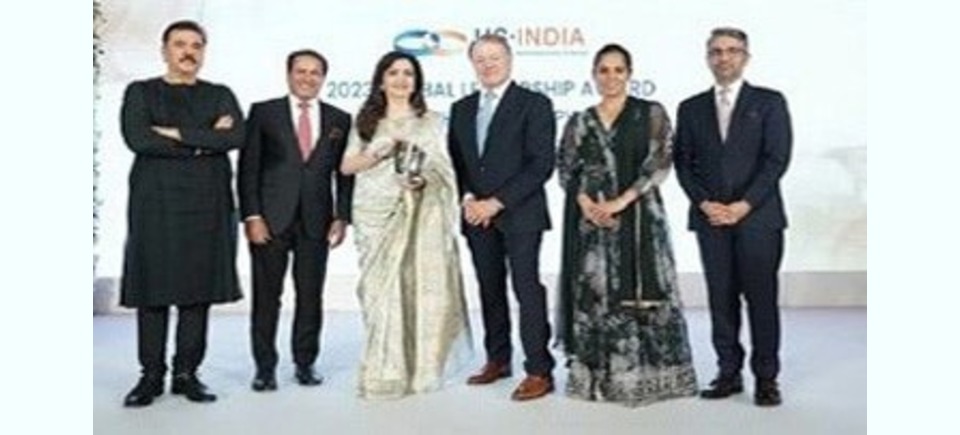
The US-India Strategic Partnership Forum (USISPF) on Sunday (October 29) awarded Nita Ambani, Founder and Chairperson of Reliance Foundation, with the 2023 Global Leadership Award for Philanthropy and Corporate Social Responsibility.
Sharing the same, USISPF wrote on X (formerly known as Twitter), “USISPF honours Ms Nita Ambani, Founder and Chairperson of @ril_foundation with the Leadership Award for Philanthropy and Corporate Social Responsibility 2023. Ms. Ambani has been at the forefront of women’s empowerment, children’s education, promoting Indian arts and sports.”
In her award acceptance speech on stage, Nita Ambani said, “Today, I accept this award with humility and gratitude on behalf of my entire team. I represent the beating heart of Reliance, our beacon of hope and empowerment – Reliance Foundation, through which we have touched the lives of over 71 million people. At Reliance, doing good and giving back has always been a way of life. Long before CSR became a norm, Reliance has been fulfilling our CMR, our Corporate Moral Responsibility. It has now transformed into our philosophy of WE CARE. We care for the planet. We care for humanity. And we care for our nation.”
Applauding USISPF for their work, she added, “I also take this opportunity to convey my deep appreciation to USISPF and its leadership for being a strong bridge in deepening the natural bonds between India and the US. In just over six years, the Forum has strengthened people-to-people and business-to-business ties between India and US.”
Dr Mukesh Aghi, USISPF President and CEO, congratulated Ambani on her achievement and said, “We are delighted to award Nita M. Ambani for her tireless efforts to enrich the lives of many Indians. Nita M. Ambani is someone who believes that the work is never done and that there is so much more left to accomplish.”
Today, Reliance Foundation also tweeted regarding the same on X and wrote, “We are honoured to announce that our Founder & Chairperson, Mrs. Nita M. Ambani, has been awarded the prestigious 2023 Global Leadership Award for Philanthropy and Corporate Social Responsibility by the US-India Strategic Partnership Forum (USISPF).”

Finance Minister Nirmala Sitharaman had a busy week along the Eastern Seaboard of the United States, traversing from Boston to the capital in Washington, DC before wrapping up her week with a cherry on top in the Big Apple.
Her visit followed closely on the heels of the inaugural in-person Quad summit in Washington, DC, where Prime Minister Narendra Modi and External Affairs Minister S Jaishankar spoke of shared diplomacy and increasingly integrated economic synergy in the Indo-Pacific region. It comes just ahead of a ‘2+2’ bilateral meeting of foreign and defence ministers, and a major Indo-Pacific Business Forum that will showcase India to thousands of business participants across the region.
Sitharaman’s visit can be understood in this larger context of India embracing shared responsibilities abroad while doubling down on investment, and economic growth at home. To this end, the minister delivered a consistent message to CEOs and investors in all three US cities: After 30 years of gradual liberalization, and seven years of bold economic reform, India’s reality has surpassed its old, outdated reputation.
“India has come a long way and has made sweeping changes by way of reforms”, she said at a recent meeting while in the US.
This year marks the 30th anniversary of the famed 1991 reforms, when India eschewed its soviet-style planned economy, and opened up to the world in a gradual process of liberalisation, privatisation, and globalisation. Progress since then has been slow, and many critical economic reforms have languished for years, even decades. The changes are now beginning to fructify.
On October 21, India completed the herculean task of administering a billion COVID-19 vaccinations. Sitharaman touched on India’s post-pandemic economic rebound, especially after the horrendous second wave of infections, and new incentive programmes in place to facilitate foreign investment.
For example, budget measures to boost the post-COVID-19 economic recovery have led to much-needed reforms in insurance, banking, and capital market regulation. Inefficient State-owned enterprises are finally being privatised, exemplified by the recent sale of Air India. Schemes such as Gati Shakti, along with the $1.5 trillion National Infrastructure Pipeline (NMP) trillion in green and brown field projects, aim to get India’s infrastructure up to speed, and reduce the investment gap with India’s G20 peers.
In finance, the creation of an asset reconstruction company to resolve bad assets in the banking system will boost financial stability and credit growth, while measures to strengthen, and simplify, dispute resolution and secondary market regulation will help investors navigate an overly-complicated financial labyrinth.
Meanwhile, one notable silver lining in the dark clouds of the COVID-19 pandemic is the remarkable uptick in technology adoption in India, and thus the burgeoning growth of FinTech, and the robust startup scene. Tech-enabled systems helped people survive the worst of the pandemic by leveraging digital means to collect direct financial support, conduct government transactions, and receive critical market information.
While in the US, Sitharaman emphasised the impact of these various reforms at four multi-lateral roundtables to 105 US industry executives, and had 17 bilateral meetings with top global CEOs. The well-attended meetings epitomised a growing investor appetite for India, including (especially) for manufacturers seeking to diversify their global supply chains in the wake of pandemic-induced constraints in China.
Washington occupied the lion’s share of meetings, with the World Bank, the International Monetary Fund (IMF) as bilateral commitments saw a meeting with John Kerry, US Special Presidential Envoy for Climate, ahead of COP26.
Meeting between Sitharaman and US Treasury Secretary Janet Yellen for the Eighth US-India Economic and Financial Partnership saw key bilateral discussions ranging from strengthening the strong commercial partnership between Washington and New Delhi, and tackling pressing issues such as COVID-19 economic recovery and climate action as both India and the US pledged to mobilising $100 billion a year through public-private partnerships to tackle the pressing climate crisis.
Global industry leaders, however, cannot base their investment strategies on a government’s political will alone; they need to see tangible progress in key areas of project execution as well. Despite the recent progress on reform investors in India remain cautious due to a lack of regulatory consistency, and transparency in the economy.
In private round table interactions with the finance minister, they have expressed concerns about the onerous data localisation mandates at the Centre and constricting labour and land laws in the states. While foreign investors welcome privatisation efforts in some sectors, they worry about consolidation of public sector entities in others, such as banking.
To attract the investment it seeks, the Government of India must redouble efforts to deepen local capital markets, reduce the cost of debt and equity financing in the country, and make it easier to hedge against currency risks. It could start by removing procedural barriers to investment, such as the high cost and lengthy time to register as a Qualified Foreign Institutional Investor (QFII) in India. Addressing these sorts of ‘next level’ challenges will be difficult, and time-consuming. But they are imperative.
As Sitharaman’s successful visit to the US showed, there is a strong strategic partnership and close commercial ties between the US and India. It was a chance for leaders on both sides — US and Indian, public and private — to reaffirm their commitment to work together, build on the momentum of recent reforms, and boost investment, jobs, and growth in India.
More information
https://www.moneycontrol.com/news/opinion/takeaways-from-nirmala-sitharamans-successful-united-states-visit-7624111.html
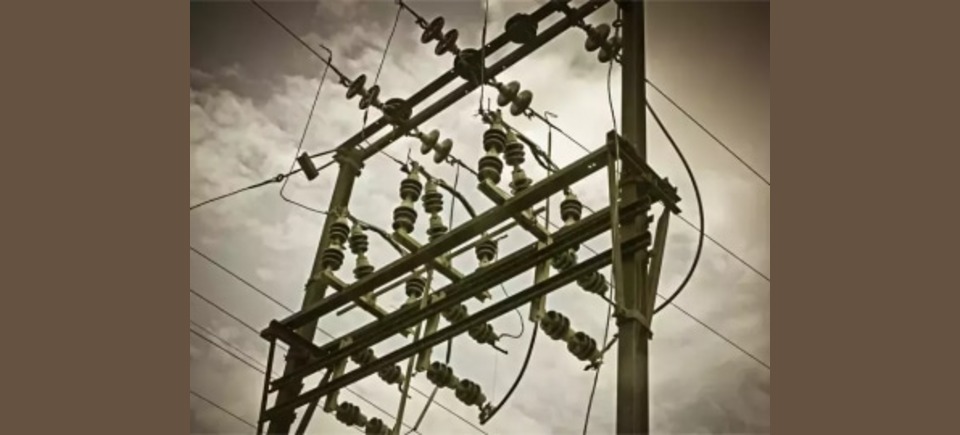
While there are positive reforms in the proposed bill, including promotion of renewable energy, improved governance, and provisions of a universal service obligation fund, there are remaining issues that need to be addressed.
New Delhi: Over the past two decades, India has pushed for significant reforms in the power sector, which have helped the country transition from a power deficit to a power surplus nation. The establishment of The Electricity Act (the “Act”) of 2003 laid the groundwork for this progress, as India attempted to reform all aspects of the power sector, including generation, distribution, transmission, trading, and consumption During this period, India pursued an aggressive capacity expansion strategy in the power sector with a focus on “Power for All”: successfully achieving a 100 percent household electrification rate. While sustained economic growth will drive electricity demand, necessitating further capacity additions, India’s power sector strategy will prioritise efficiency, decarbonization, modernization, and reliability of power sector assets. Investments from foreign and domestic investors in the power sector will be the key to achieve these objectives, especially in realizing Prime Minister Modi’s ambition of raising the deployment of renewable energy capacity by five-fold to 50 GW by 2030. This investment into energy is also reflected in realignment of India’s diplomatic outreach. A case in point is India’s growing energy security cooperation with the United States, which recently saw the relaunch of the US-India Strategic Clean Energy Partnership, which will aid in the acceleration of the deployment of affordable, reliable, and sustainable energy solutions.
In light of recent reforms, The Electricity (Amendment) Bill (the “Bill), 2021 can open up the power sector for additional investments by incorporating structural changes, in addition to the existing liberal foreign direct investment (FDI) policies One of the key proposals of The Electricity (Amendment) Bill, 2021, is to bring in revisions to the Act to end the monopoly of state-run power distribution utilities (DISCOMs) and to delicense power distribution Distribution of electricity is sacrosanct to the power industry. The proposed reforms appear significant and timely, given that despite two decades of power sector reforms, many electricity distribution companies finances are still in poor shape, as the majority of DISCOMs are unable to pay generation and transmission companies, as well as banks and financial institutions. Furthermore, while efficiency improvement efforts aimed at reducing technical and commercial losses have yielded results, with overall AT&C losses in India’s DISCOMs hovering around 22 percent, significant reforms are required to be considered on par with better-run utilities elsewhere in the world.
The bill envisages to increase the private sector participation in the distribution sector introducing competition and creating a framework that allows the power consumer to select their own supplier. This will lead to fresh investments into the sector, increased adoption of cutting-edge technologies and a more resilient network infrastructure. It is significant to note that the current outstanding dues owed to generator by DISCOMs on a pan-India basis total Rs 98,450 crore (as of Sept 2021, PRAPTI portal), which jeopardises the power sector’s financial sustainability and erodes investor sentiment significantly. The poor financial health of the DISCOMs has also prevented investors from funding infrastructure needed to improve the supply quality and to integrate renewable energy coming online. The various proposals of the bill, such as Direct Benefits Transfer to deposit power subsidies to end beneficiaries account and introduction of time limit for adoption of tariff determination, aim to relieve DISCOMs financial burden. Payment security for power generators, as proposed in the bill, is key to a stable investment climate and the ability to attract greater FDI into the sector.
While there are other positive reforms in the proposed bill, including promotion of renewable energy, improved governance, and provisions of a universal service obligation fund, there are remaining issues that need to be addressed.
Fears of Centralization:
While the bill empowers the National Load Dispatch Centre (NLDC) with the responsibility of ensuring the safety and stability of the pan-india grid, the Regional Load Dispatch Centres (RLDCs) and State Load Dispatch Centres (SLDCs) also need to be strengthened. The regional and state system operators can be made responsible for monitoring payments to all generating entities, ensuring the establishment of payment security and uploading curtailment data of the grid and its constituents. This will facilitate the Bill’s robust implementation. given the concurrent structure of the power sector, and will empower system operators at all levels to act transparently.
Need for strengthening the RE Framework:
All entities defined in the Act should be bound by the provisions of the National Renewable Energy Policy (NREP), the National Tariff Policy, and the National Electricity Policy, which have historically been regarded as merely guiding documents, diluting their true intent. Additionally, generation of electricity from renewable energy sources should be enshrined as a must-run provision in the Bill, as these sources are reliant on environmental resources that are beyond human control. The Bill should include stringent penalties for non-compliance and curtailment for non-grid security-related reasons.
Clarity on delicensing of distribution:
The Bill should clarify the distribution sub-licensee’s roles and responsibilities, as well as the way they are intended to operate within their operational and contractual framework.
Demarcation of Powers:
A clear division of authority between the Electricity Regulatory Commissions (ERCS) and the Electricity Contract Enforcement Authority (ECEA) is necessary for contract performance issues. Disputes such as extensions of Scheduled Commercial Operation Dates (SCOD), Change in Law relief, and Force Majeure claims, while purely contractual in nature, have the potential to affect the tariff and may result in contract termination.
The Indian power sector continues to be one of the most attractive investment opportunities globally, as evidenced by India’s remarkable progress in renewable energy deployment, with 136 GW of installed renewable capacity now accounting for 38 percent of its installed electricity generation. However, COVID-19 has had a negative impact on investment inflows, with FDI inflows into the Indian power sector falling to 61 percent in 2019-20 and 34 per cent in 2020-21, respectively. from 2018-19 levels. With rising power demand over the last few months indicating that India’s economy has entered a strong recovery, the situation is expected to reverse soon.
A new wave of inclusive and holistic power sector reforms is necessary to transform DISCOMs and the electricity grid. This is in order to sustain India’s economic recovery, maintain the country’s transition to sustainable forms of renewable energy, and attract the FDI required to meet the country’s ambitious energy and climate targets. Through the recently launched U.S.-India Climate and Clean Energy Agenda 2030 Partnership, President Biden and Prime Minister Modi announced several priority areas of collaboration that would help modernize the power sector to support large-scale integration of renewables and facilitate investment to accelerate India’s clean energy transition. If the proposed amendments to The Electricity (Amendment) Bill, 2021 are implemented by addressing the issues raised above, they will go a long way toward achieving these goals by improving the investment climate in the renewable sector. As COP 26 nears in Glasgow, Scotland, these collective efforts will help develop a cleaner energy roadmap with additional low carbon routes.
More information
https://energy.economictimes.indiatimes.com/news/power/opinion-issues-that-remain-unaddressed-in-electricity-amendment-bill-2021/87142459
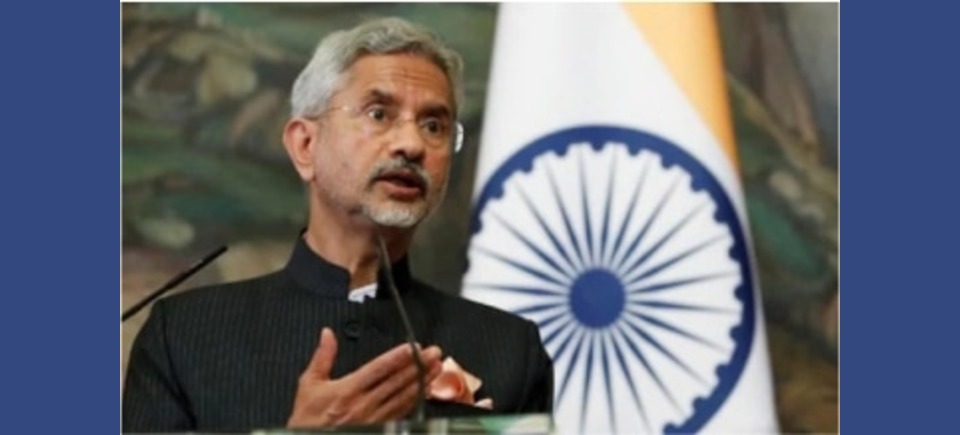
External Affairs minister Jaishankar also suggested that India was in no hurry to deliberate on giving any recognition to the new dispensation in Kabul.
India was not taken into confidence on various aspects of the Doha deal inked between the US and the Taliban last year and the latest developments in Afghanistan will have “very, very significant consequences” for the region and beyond, External Affairs Minister S Jaishankar has said.
He also said that the key concerns for India at this juncture included whether Afghanistan will have an inclusive government and that Afghan soil is not used for terrorism against other states and the rest of the world.
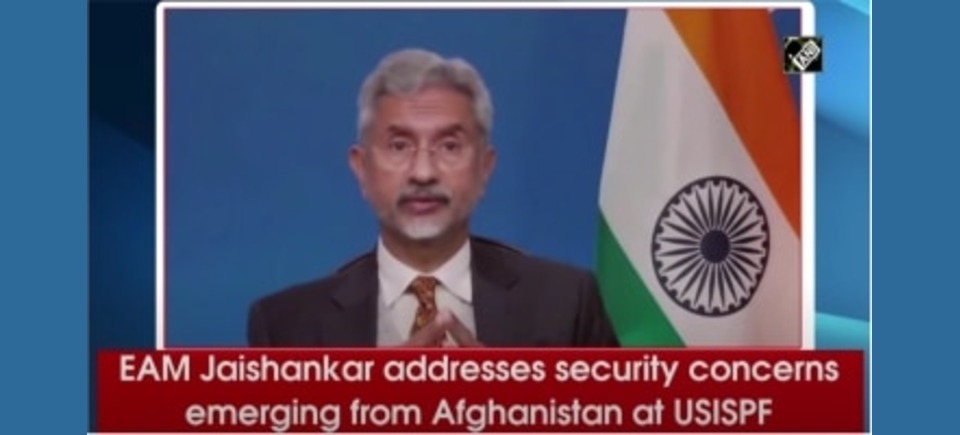
Speaking virtually at the annual leadership summit of the US-India Strategic Partnership Forum (USISPF) this week, Jaishankar also suggested that India was in no hurry to deliberate on giving any recognition to the new dispensation in Kabul.
In an interactive session with former American ambassador Frank Wisner, the external affairs minister also said that the Quad or Quadrilateral coalition comprising India, the US, Australia and Japan is not against any country and it should not be seen as some kind of “ganging up” and a negatively driven initiative.
India and the US are on the same page on many issues relating to the recent developments in Afghanistan including apprehensions about the possible use of Afghan soil for terrorism.
“I think, to some degree, we would all be justified in having levels of concern and to some degree, I think the jury’s still out. When I say levels of concern, you know, there were commitments which were made by the Taliban, at Doha, I mean, the US knows that best I mean, we were not taken into confidence on various aspects of that,” he said.
“So whatever, whether deal which was struck in Doha, I mean, one has a broad sense. But beyond that, you know, are we going to see an inclusive government? Are we going to see respect for the rights of women, children, minorities?” he asked.
“Most important are we going to see an Afghanistan whose soil is not used for terrorism against other states and the rest of the world, I think, these are our concerns,” Jaishankar added.
He said what had happened in Afghanistan, is going to “have very, very significant consequences for all of us, and we are so close to the region.”
The minister said that the key concerns were captured by a UN Security Council resolution in August and that how those questions are addressed today is still an open question, which is why “I said the jury is still out”.
“If you ask me is this the time to draw sharp conclusions, I would sort of take my time and study this with a certain degree of deliberation, because as I said, a lot of this, whatever understandings, there have been, many of these are not known to the entire international community,” he added.
To another question on how India and the US looked at the situation in Afghanistan, Jaishankar said both sides are on a similar page, at a principle level on many of the issues, particularly on the possible usage of Afghan soil for terrorism.
He said the issue figured in discussions between Prime Minister Narendra Modi and US President Joe Biden in Washington last week.
“Again, look, there would be issues on which we would agree more, there would be issues on which we would agree less. Our experiences in some respects are different than yours (the US). You know, we have been victims of cross border terrorism ourselves from that region,” Jaishankar said.
“And let us say that has shaped in many ways, our view of some of the neighbours of Afghanistan. So now, how much, the US shares that view, and where is it that the US sort of makes its tactical compromises I think that is for the Americans to figure out,” he said.
Asked whether it included a joint signal to Pakistan, he only said: “There are aspects that we share, and there are aspects where maybe our positions are not exactly the same.”
To a query on Quad and ways to manage the rise of Chinese power, Jaishankar said the four-nation partnership is not against somebody.
“I think it’s very important not to be sort of railroaded into some kind of negative discourse, which actually is not from our script, it is somebody else’s script. And I don’t think we should fall for that. I think we need to be positive,” he said.
More information
https://www.news18.com/news/india/in-a-first-india-hints-at-not-being-taken-into-confidence-on-various-aspects-of-us-taliban-deal-4280309.html
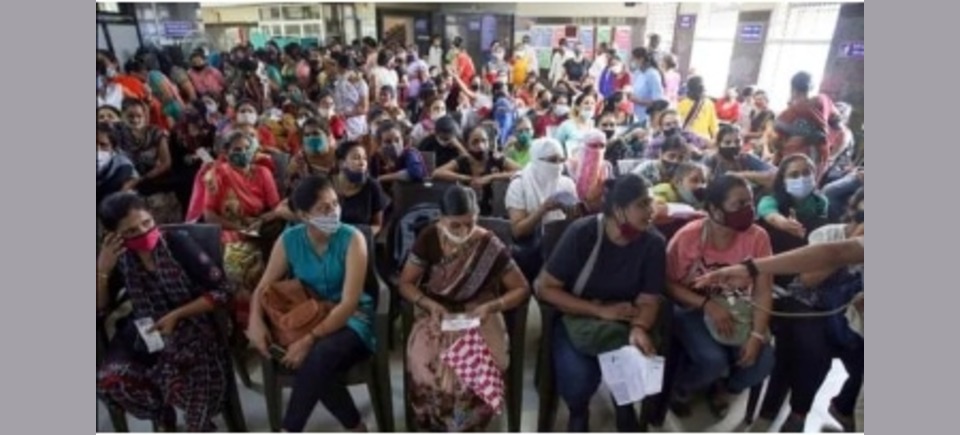
Called the US-India Alliance for Women’s Economic Empowerment, the initiative is a joint partnership of the US state department, USAID, the US-India Strategic Partnership Forum and George Washington University.
The United States on Friday launched a public-private initiative to help women entrepreneurs in India.
Called the US-India Alliance for Women’s Economic Empowerment, the initiative is a joint partnership of the US state department, US Agency for International Development (USAID), the US-India Strategic Partnership Forum (USISPF) and George Washington University.
USAID administrator Samantha Power launched it at the final day of the annual leadership summit of the USISPF.
She noted that the Covid-19 pandemic disproportionately impacted marginalised populations, according to a statement from the USISPF. She also highlighted the difficulties women have accessing financial services to increased pressures balancing unpaid care and domestic work while working, and increased underemployment and business closures.
USISPF CEO Mukesh Aghi said, “We look forward to working with our member companies to boost entrepreneurship and job opportunities that will enhance economic prosperity and inclusion in India.”
The alliance is expected to focus on three areas of action: accelerating women’s entrepreneurship, fostering leadership in the workforce and providing access to career enhancing education and skills building opportunities.
More information
https://www.hindustantimes.com/world-news/us-initiative-to-help-women-entrepreneurs-in-india-101633113339589.html
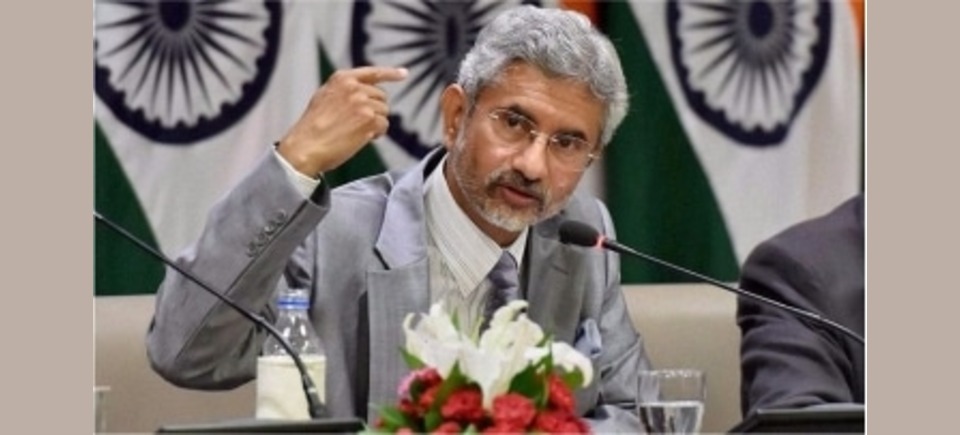
Jaishankar said India was in no hurry ‘to deliberate’ on recognising the Taliban regime in Kabul.
External Affairs Minister S Jaishankar on Thursday, 30 September, said that the latest developments in Afghanistan would have “very significant consequences” for India and the rest of the world, reported ANI.
Speaking virtually at the annual leadership summit of the US-India Strategic Partnership Forum (USISPF) on Thursday, Jaishankar said a few critical concerns for India were whether Afghanistan would have an inclusive government and if its soil would be used for terrorism against other states, reported PTI.
Jaishankar also said India was in no hurry ‘to deliberate’ on recognising the Taliban regime in Kabul.
While interacting with former American ambassador Frank Wisner, he said India and the US were on the same page on many issues regarding the recent developments in Afghanistan, especially about its soil being used for terrorism.
‘India Not Taken Into Confidence on Various Aspects of US-Taliban Doha Deal’
However, Jaishankar said that “India was not taken into confidence on various aspects” of the deal signed between the US and the Taliban in Doha last year.
“I think, to some degree, we would all be justified in having levels of concern, and to some degree, I think the jury’s still out. When I say levels of concern, you know, there were commitments which were made by the Taliban, at Doha, I mean, the US knows that best I mean, we were not taken into confidence on various aspects of that,” he said.
“So whatever, whether deal which was struck in Doha, I mean, one has a broad sense. But beyond that, you know, are we going to see an inclusive government? Are we going to see respect for the rights of women, children, minorities?” he asked.
“Most importantly, are we going to see an Afghanistan whose soil is not used for terrorism against other states and the rest of the world, I think, these are our concerns,” Mr Jaishankar added.
He also said that the Quad, comprising India, the US, Australia and Japan, was not against any country and should not be seen negatively or as some kind of ‘ganging up’.
I think it’s very important not to be sort of railroaded into some kind of negative discourse, which actually is not from our script, it is somebody else’s script. And I don’t think we should fall for that. I think we need to be positive,” he said, according to PTI.
‘Quad Members Each Have a Very Substantial Relationship with China
When asked about dealing with the rise of China, Jaishankar said, “I would say, in many ways, those are bilateral choices that all of us have to make, we each have a very substantial relationship with China. And, in many ways, China being today, is such a big player and so salient in the international economy, I think it’s natural that these relationships are quite unique. So what are my problems, or my opportunities would not be the same as that for the US, or Australia, or Japan, or Indonesia or France,” he added.
Jaishankar hinted at the importance of trying to normalise the conversation with China.
“So as participants in the international order, we need to assess that and respond to that, in the light of our own interest. So I think it’s sort of essential to look to normalise this conversation,” he said.
More information
https://www.thequint.com/news/world/afghanistan-taliban-s-jaishankar
Synopsis
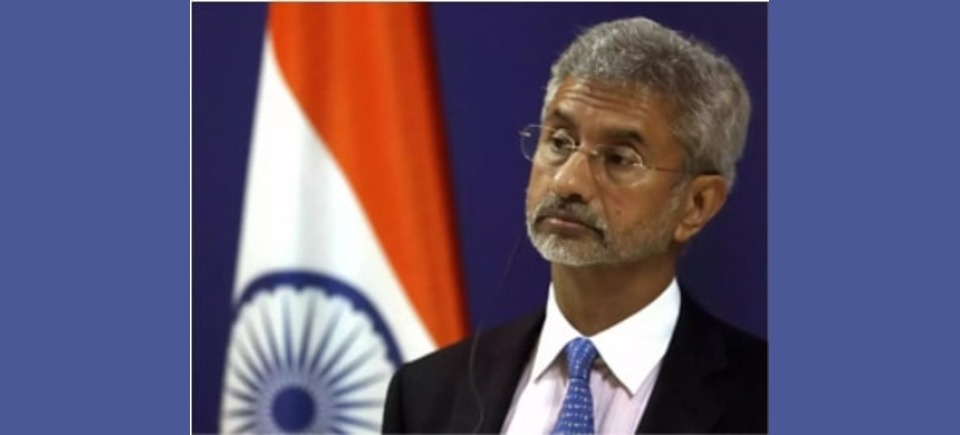
“India has a very substantial relationship with Beijing and Quad is for things, not against someone,” S Jaishankar said when asked about India and US’s perspective on handling the issue of the emergence of China.
External affairs minister S Jaishankar has expressed regret that India’s views were not sought when the Afghanistan peace deal was being worked out in Doha and said the jury is still out on how well the Taliban regime will govern the nation.
“Whatever were the peace deals struck in Doha, we weren’t taken into confidence for that. The jury is still out on how this new regime governs Afghanistan. Are we concerned, yes, but we have to take time and study this,” Jaishankar said at the fourth Annual Leadership Summit of US-India Strategic Partnership Forum (USISPF) on Thursday.
But he suggested that the Quad can play an important role. “Afghanistan presents issues for the region. The Indo-Pacific is an important region and should be based on a rules-based international order and respecting territorial integrity,” Jaishankar said, adding, “In the past, we haven’t worked together in South Asia, but that’s changing, given the changing dynamics of the Indo-Pacific. The Quad platform is important on that front, and now Afghanistan too, given the security factor.”
He, however, tried to dispel China’s fears over Quad. “India has a very substantial relationship with Beijing and Quad is for things, not against someone,” Jaishankar said when asked about India and US’s perspective on handling the issue of the emergence of Communist power. “We shouldn’t be railroaded into a negative discourse and read from someone else’s script.”
“As participants in the international order, we need to assess Beijing’s movement and respond to that in the light of our own interest,” the minister said, as he highlighted that the Quad is a strategic dialogue between nations aimed at discussing the natural consequence of events in the region and “not a gang to pitch one’s personal agenda”.
More information
https://economictimes.indiatimes.com/news/india/india-not-taken-into-confidence-over-doha-peace-deals-s-jaishankar/articleshow/86698007.cms

The partnership aims to bring together American investors into Indian businesses, philanthropists, academic institutions and civil society.
A top American aid agency and a non-profit business advocacy group here on Friday announced a public-private partnership to advance women’s economic empowerment in India.
“I’m here to announce today the launch of the US India Alliance for Women’s Economic Empowerment, along with the US, India Strategic and Partnership Forum (USISPF), and George Washington University (GWU),” Samantha Power, Administrator of United States Agency for International Development (USAID), told a virtual audience during the Fourth Annual Leadership Summit of the USISPF.
The partnership aims to bring together American investors into Indian businesses, philanthropists, academic institutions, and civil society.
The goal is to support women entrepreneurs, provide better job access, build careers, along with mentorship, Power said, participating in the USAID discussion with former US Ambassador to India, Richard Verma.
The President Joe Biden-led US administration is pursuing a comprehensive plan to promote women’s economic empowerment, help end gender-based violence and tackle other inequalities, she said.
USISPF president Mukesh Aghi will co-chair the alliance with Assistant Secretary of State for South and Central Asian Affairs Don Lu, Senior Official for the Office of Global Women’s Issues Katrina Fotovat and USAID Assistant Administrator for Asia Karen Freeman.
Speaking at the virtual event, Aghi said, “As we celebrate India at 75, the USISPF has taken a close look at what more we can do to truly achieve inclusive prosperity in India.”
Noting India’s demographic scape, he said greater inclusion of women in the economy will be critical to advancing India’s economic growth.
He pointed out that the International Monetary Fund projects are increasing gender parity in the economy, enabling it to target double-digit Gross Domestic Product growth.
Earlier this year, the USAID and the USISPF launched South Asian Women and Energy Effort, an initiative to increase the presence of women in the sector.
A key study by Food and Agriculture Organization recently said if women farmers had the same access to resources as their male counterparts, the number of hungry people in the world could reduce by 100 million to 150 million people, Power said, explaining the need of gender equality in the economy.
“So, this alliance has been in the works for some time, well before my time coming on board, and joining the Biden administration. Launching the alliance is the first step,” she said.
Power announced the alliance’s first two initiatives Women@Work and the India Million Women Mentors Initiative.
Women@Work will develop a coalition of businesses, philanthropic organisations, and other stakeholders to address the needs of marginalised women economically impacted by the pandemic.
Women@Work fosters access to finance and business digitisation, accelerates women’s empowerment through supplier diversity, helps grow the care economy, and assists in the transition of women business owners in the informal economy to become formally registered.
Aspects of Women@Work are supported by the USAID-funded platform REVIVE Alliance.
The India Million Women Mentors Initiative aims to connect one million women and girls in India with mentors over the next five years.
More information
https://yourstory.com/herstory/2021/10/usaid-partnership-advance-women-economic-empowerment/amp

External Affairs Minister S Jaishankar said that India and the US are on the same page on many issues related to recent developments in Afghanistan.
India was not taken into confidence on various aspects of the Doha deal struck between the US and the Taliban last year, External Affairs Minister S Jaishankar said on Thursday.
At the same time, Jaishankar said India and the US are on the same page on many issues relating to the recent developments in Afghanistan including apprehensions about the possible use of Afghan soil for terrorism.
Speaking virtually at the annual leadership summit of the US-India Strategic Partnership Forum (USISPF), he also suggested that there are some aspects relating to the Afghan crisis where the positions of the two countries are not exactly the same.
“I think to some degree, we would all be justified in having levels of concern and to some degree, I think the jury is still out. When I say levels of concern, the commitments which were made by the Taliban at Doha, the US knows it best. We were not taken into confidence on various aspects of that,” he said.
The deal was signed between the US and the Taliban in Doha in February last year in which the US promised to withdraw its troops from Afghanistan while the Taliban committed to several conditions including ending violence.
The external affairs minister also noted that any question on according recognition to the Taliban dispensation has to be based on fulfilling of the commitments made by the group in the Doha agreement.
“I think we are on similar pages at a principle level on many of these issues, certainly say terrorism. The use of Afghan soil for terrorism is something both of us feel so strongly and it was something which was discussed when Prime Minister Narendra Modi met President Joe Biden,” he said when asked about the position of the US and India towards the Afghan crisis.
The developments in Afghanistan figured in talks between Modi and Biden in Washington last week.
“There will be issues on which we will agree more, there will be issues on which we will agree less. Our experiences in some respects are different from yours (the US). We have been victims of cross-border terrorism ourselves from that region and that has shaped in many ways our view of some of the neighbours of Afghanistan,” he said, in an apparent reference to Pakistan.
The external affairs minister said it is for the US to decide whether it shares that view, adding that India has concerns over the developments in Afghanistan.
Jaishankar said the most pertinent questions relating to Afghanistan are whether it will have an inclusive government and whether the rights of women, children and minorities are going to be ensured.
“Most importantly, are we going to see an Afghanistan whose soil is not used for terrorism against other states and the rest of the world. I think these are the concerns and these concerns were captured by a UN Security Council resolution in August,” he said.
“When we look at what happened in Afghanistan and the region, I think these are going to have very very significant consequences for all of us. And we are so close to the region. There are a set of concerns and issues that flow from that,” Jaishankar said.
To a question on recognising the Taliban dispensation, he suggested that New Delhi would take its time and study the situation.
On the Quad or Quadrilateral coalition, the external affairs minister said it has a broad agenda of cooperation including in the Indo-Pacific region. He said Quad should not be seen as “some kind of ganging up” against China.
Asked about India’s ties with the US, he said they are at an important juncture and that the discussions in Washington opened up many more new possibilities.
More information
https://www.indiatoday.in/india/story/india-us-afghanistan-external-affairs-minister-jaishankar-1859403-2021-10-01
ABOUT:
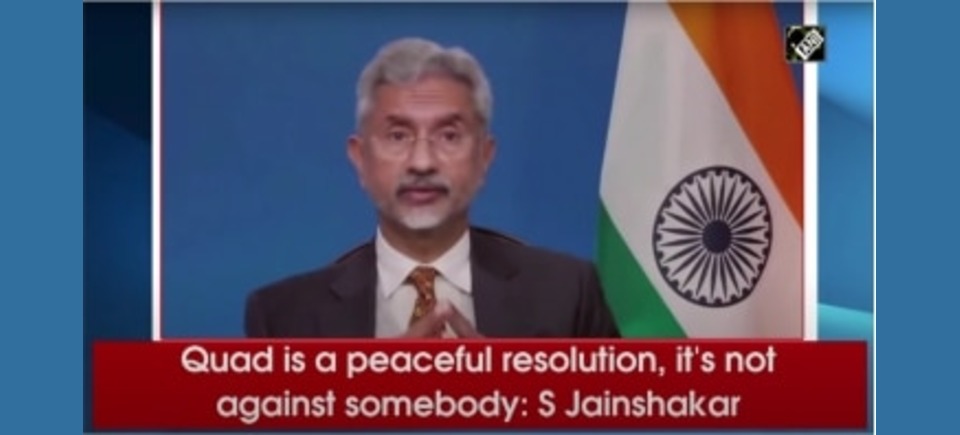
EAM S Jaishankar addressed the USISPF Leadership Summit on how to deal with the ‘Rise of China’. He said, “I want to make one thing clear – Quad is a peaceful resolution, it’s not against somebody. It’s important not to be railroaded into some kind of negative discourse and we should not fall for it. We should be positive.” He further added, “In many ways, they are bilateral choices we have to make. China is such a big player, salient in the international economy… What are my problems would not be the same as yours, but there should not some kind of ‘ganging up’.”
Synopsis
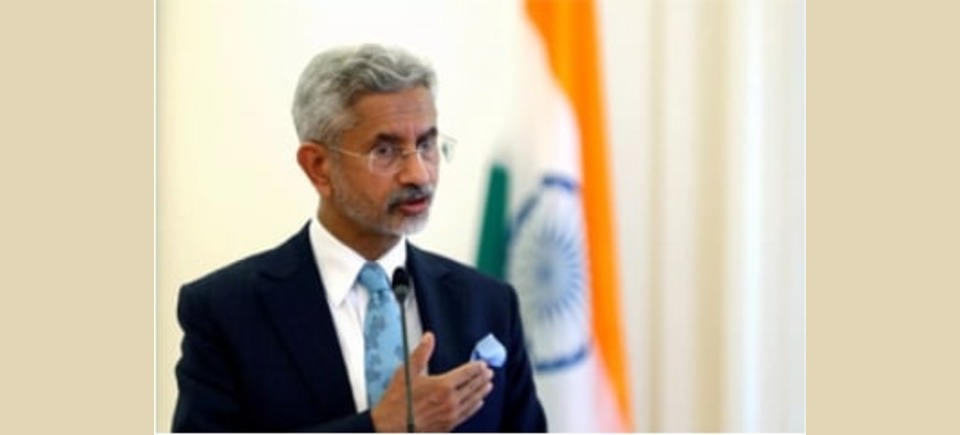
Speaking virtually at the annual leadership summit of the US-India Strategic Partnership Forum (USISPF) on Thursday, Jaishankar also suggested that India was in no hurry to deliberate on giving any recognition to the new dispensation in Kabul.
India was not taken into confidence on various aspects of the Doha deal inked between the US and the Taliban last year and the latest developments in Afghanistan will have “very, very significant consequences” for the region and beyond, External Affairs Minister S Jaishankar has said.
He also said that the key concerns for India at this juncture included whether Afghanistan will have an inclusive government and that Afghan soil is not used for terrorism against other states and the rest of the world.
Speaking virtually at the annual leadership summit of the US-India Strategic Partnership Forum (USISPF) on Thursday, Jaishankar also suggested that India was in no hurry to deliberate on giving any recognition to the new dispensation in Kabul.
In an interactive session with former American ambassador Frank Wisner, the external affairs minister also said that the Quad or Quadrilateral coalition comprising India, the US, Australia and Japan is not against any country and it should not be seen as some kind of “ganging up” and a negatively driven initiative.
India and the US are on the same page on many issues relating to the recent developments in Afghanistan including apprehensions about the possible use of Afghan soil for terrorism.
“I think, to some degree, we would all be justified in having levels of concern and to some degree, I think the jury’s still out. When I say levels of concern, you know, there were commitments which were made by the Taliban, at Doha, I mean, the US knows that best I mean, we were not taken into confidence on various aspects of that,” he said.
“So whatever, whether deal which was struck in Doha, I mean, one has a broad sense. But beyond that, you know, are we going to see an inclusive government? Are we going to see respect for the rights of women, children, minorities?” he asked.
“Most important are we going to see an Afghanistan whose soil is not used for terrorism against other states and the rest of the world, I think, these are our concerns,” Jaishankar added.
The Doha deal was signed between the US and the Taliban in February last year in which the US promised to withdraw its troops from Afghanistan while the Taliban committed to several conditions including ending violence.
Jaishankar said what had happened in Afghanistan, is going to “have very, very significant consequences for all of us, and we are so close to the region.”
He said that the key concerns were captured by a UN Security Council resolution in August and that how those questions are addressed today is still an open question, which is why “I said the jury is still out”.
“If you ask me is this the time to draw sharp conclusions, I would sort of take my time and study this with a certain degree of deliberation, because as I said, a lot of this, whatever understandings, there have been, many of these are not known to the entire international community,” he added.
To another question on how India and the US looked at the situation in Afghanistan, Jaishankar said both sides are on a similar page, at a principle level on many of the issues, particularly on possible usage of Afghan soil for terrorism.
He said the issue figured in discussions between Prime Minister Narendra Modi and US President Joe Biden in Washington last week.
“Again, look, there would be issues on which we would agree more, there would be issues on which we would agree less. Our experiences in some respects are different than yours (the US). You know, we have been victims of cross border terrorism ourselves from that region,” Jaishankar said.
Asked whether it included a joint signal to Pakistan, he only said: “There are aspects that we share, and there are aspects where maybe our positions are not exactly the same.”
To a query on Quad and ways to manage the rise of Chinese power, Jaishankar said the four-nation partnership is not against somebody.
“I think it’s very important not to be sort of railroaded into some kind of negative discourse, which actually is not from our script, it is somebody else’s script. And I don’t think we should fall for that. I think we need to be positive,” he said.
On the question of how to deal with the rise of China, Jaishankar said: “I would say, in many ways, those are bilateral choices that all of us have to make, we each have a very substantial relationship with China.”
“And, in many ways, China being today is such a big player and so salient in the international economy, I think it’s natural that these relationships are quite unique. So what are my problems, or my opportunities would not be the same as that for the US, or Australia, or Japan, or Indonesia or France,” he added.
Jaishankar said it would be different for each country and added that the rise of China has had a very fundamental impact on the international order.
“So as participants in the international order, we need to assess that and respond to that, in the light of our own interest. So I think it’s sort of essential to normalise this conversation,” he said.
“This should not end up as though it’s some kind of ganging up and a negatively driven event, I don’t think that’s the fair description of what is a completely natural evolution of international order to my mind,” he added.
Talking about geopolitical issues, Jaishankar said he saw a big change at the American approach as it has shown a much greater willingness to work with other partners, “not necessarily on terms that the US has unilaterally set”.
“I think the US is also getting beyond that era of alliances and treaty-based relationships. It’s a far more flexible, I would say diverse differentiated world out there and I think US policy makers are beginning to adjust to that and some of that you’ll see in arrangements like Quad,” he added.
ABOUT:
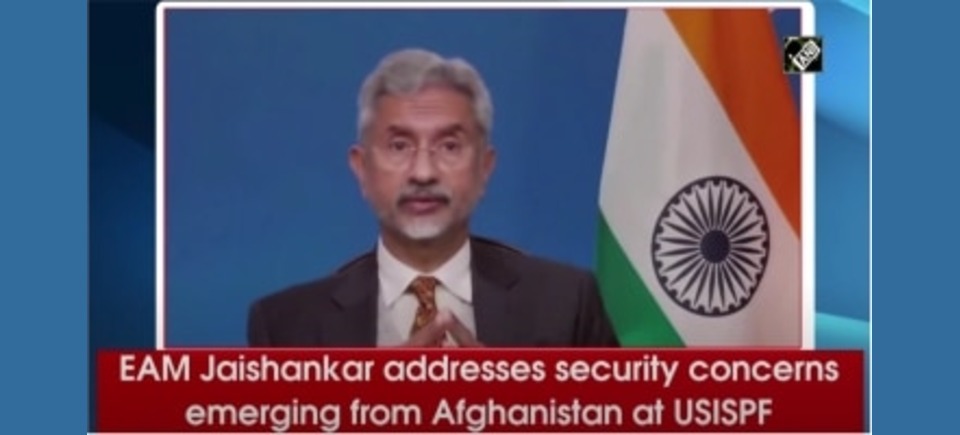
Minister of External Affairs S Jaishankar virtually addressed the fourth Annual Leadership Summit of the US-India Strategic Partnership Forum (USISPF) which began on September 29.
He said, “Afghanistan presents issues for the region, the Indo-Pacific is an important region and should be based on a rules-based international order and respecting territorial integrity.”
He further mentioned, “In the past, we haven’t worked together in South Asia, but that’s changing, given the changing dynamics of the Indo-Pacific, the Quad platform is important on that front, and now on Afghanistan given the security factor.”
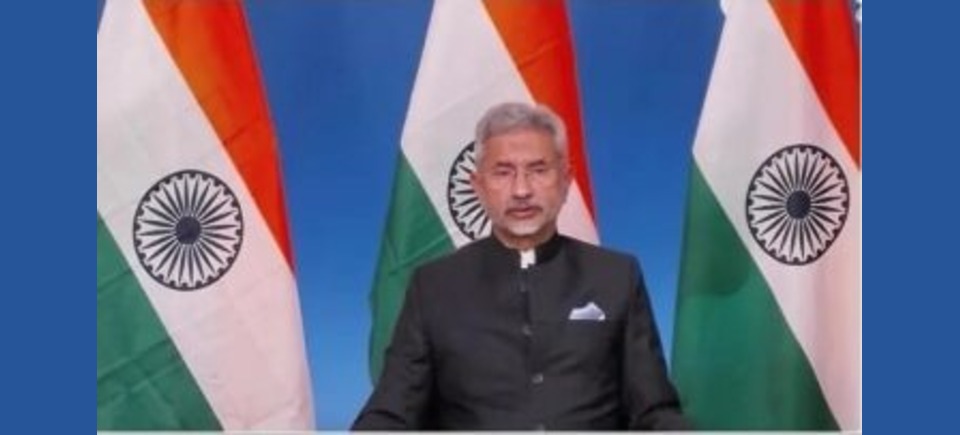
India on Thursday reiterated that New Delhi has maintained a very substantial relationship with China and asserted that there were some international issues that would be solved bilaterally. The statement from India’s External Affairs Minister S Jaishankar came in response to a question over New Delhi’s stand on handling China’s ascent.
Jaishankar was holding a virtual discussion with the US Ambassador to India, Frank Wisner, at an event organised by the US India Strategic Partnership Forum (USISPF) on September 30. “India has a very substantial relationship with Beijing and Quad is for things, not against someone. We shouldn’t be railroaded into a negative discourse and read from someone else’s script,” India’s External Affairs Minister said when asked about New Delhi and Washingon’s perspective on handling the perplexing issue of the emergence of Communist power.
Further, the Indian diplomat noted that Beijing has had a significant influence on the global order but suggested that countries respond with respect to their own interests and concerns. “As participants in the international order we need to assess Beijing’s movement and respond to that in the light of our own interest,” stressed Jaishankar during the US India Strategic Partnership Forum meeting. He highlighted that the Quadrilateral Security Dialogue (Quad) is a strategic dialogue between the United States, India, Japan and Australia, aimed to discuss the natural consequence of events in the region, “not a gang to pitch one’s personal agenda”.
Jaishankar attacks Pakistan on Afghanistan issue
Apart from discussing Chinese aggression, EAM S Jaishankar noted the recent discussion between Indian Prime Minister Narendra Modi and US President Joe Biden in Washington on the sidelines of the UN General Assembly session has opened up many more new possibilities.
The top Indian diplomat said both New Delhi and Washington are on the same page on various issues associating with the current developments in Afghanistan. He asserted both India and America are the victims of terrorism nurtured by the same Talibani group which has been funded by some of the neighbouring countries. Notably, Jaishankar was pointing fingers at Pakistan without naming the Imran Khan-led government. “There will be issues on which we will agree more, there will be issues on which we will agree less. Our experiences in some respects are different from yours (the US). We have been victims of cross-border terrorism ourselves from that region and that has shaped in many ways our view of some of the neighbours of Afghanistan,” he said during the USISPF Annual Leadership Summit.

Washington, Oct 1 (PTI) A top American aid agency and a non-profit business advocacy group here on Friday announced a public-private partnership to advance women’s economic empowerment in India.
“I”m here to announce today the launch of the US India Alliance for Women’s Economic Empowerment, along with the US, India Strategic and Partnership Forum (USISPF), and George Washington University (GWU),” Samantha Power, Administrator of United States Agency for International Development (USAID), told a virtual audience during the Fourth Annual Leadership Summit of the USISPF.
The partnership aims to bring together American investors into Indian businesses, philanthropists, academic institutions and the civil society.
The goal is to support women entrepreneurs, provide better job access, build careers, along with mentorship, Power said, participating in the USAID discussion with former US Ambassador to India Richard Verma.
The President Joe Biden-led US administration is pursuing a comprehensive plan to promote women’s economic empowerment, help end gender-based violence and tackle other inequalities, she said.
USISPF president Mukesh Aghi will co-chair the alliance with Assistant Secretary of State for South and Central Asian Affairs Don Lu, Senior Official for the Office of Global Women”s Issues Katrina Fotovat and USAID Assistant Administrator for Asia Karen Freeman.
Speaking at the virtual event, Aghi said, “As we celebrate India at 75, the USISPF has taken a close look at what more we can do to truly achieve inclusive prosperity in India.”
Noting India’s demographic scape, he said greater inclusion of women in the economy will be critical to advancing India”s economic growth.
He pointed out that the International Monetary Fund projects are increasing gender parity in the economy, enabling it to target double digit Gross Domestic Product growth.
Earlier this year, the USAID and the USISPF launched South Asian Women and Energy Effort, an initiative to increase the presence of women in the sector.
A key study by Food and Agriculture Organization recently said if women farmers had the same access to resources as their male counterparts, the number of hungry people in the world could reduce by 100 million to 150 million people, Power said, explaining the need of gender equality in the economy.
“So, this alliance has been in the works for some time, well before my time coming on board, and joining the Biden administration. Launching the alliance is the first step,” she said.
Power announced the alliance’s first two initiatives Women@Work and the India Million Women Mentors Initiative.
Women@Work will develop a coalition of businesses, philanthropic organisations, and other stakeholders to address the needs of marginalised women economically impacted by the pandemic.
Women@Work fosters access to finance and business digitisation, accelerates women’s empowerment through supplier diversity, helps grow the care economy, and assists in the transition of women business owners in the informal economy to become formally registered.
Aspects of Women@Work are supported by the USAID-funded platform REVIVE Alliance.
The India Million Women Mentors Initiative aims to connect 1 million women and girls in India with mentors over the next five years.
More information
https://www.outlookindia.com/newsscroll/usaid-announces-partnership-to-advance-womens-economic-empowerment-in-india/2171239
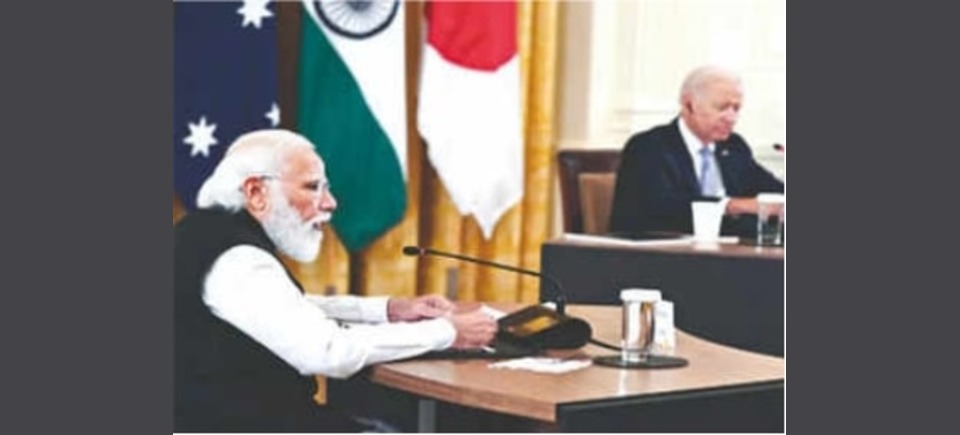
NEW DELHI: In the post-pandemic world, the Indo-US relationship is ready to scale new heights and the recent meeting between Prime Minister Narendral Modi and US President Joe Biden set the tone for enhanced ties, Tata Sons Chairman N Chandrasekaran said on Thursday.
At the US-India Strategic Partnership Forum (USISPF) annual leadership summit, Chandrasekaran also said the two countries can play a significant role in the development of infrastructure in India, considering how they have helped each other during the pandemic.
“In particular, I believe the US-India relationship, bolstered by each country helping the other during this trying time, is ready to scale new heights,” he said while accepting the USISPF Global Leadership Award.
He further said,” The rebalancing the global supply chains, transition to sustainable future, the dramatic acceleration in digital, and the future investments that are necessary in healthcare and education, provide huge opportunities for both countries to work constructively together to make the world a better place”.
Asked about the significance of the recent meeting between Modi and Biden in the US, Chandrasekaran said, “First of all, let me say that these meetings are historic, and they make a significant impact because they set the tone. US and India, all of us know, especially in business, we are natural partners and allies”
While there may be cooperation at the defence level or any other sphere, he said. “At the business level in terms of the economic impact that we can make on each other, is just humongous.”
Stating that both leaders emphasised on how the two countries can work with each other, he said, “It’s a very strong signal, and many things will happen. And we should be at least aspiring to increase our trade….”
Reiterating that India can emerge as a “very, very important player in the rebalancing of the new global supply chain”, he said, “We should create a resilient global supply chain. We should move from just in time to just in case supply chains so that the global system doesn’t fail.”
The world faced issues in the supply chain, not only in terms of economic activity and businesses production, but also in procuring medical assistance during the pandemic, he noted.
“In the post-pandemic world, India and the US can play a significant role in the development of infrastructure in India, in the whole digital area, and defining the complex issues around data,” Chandrasekaran asserted.
Citing the example of Aadhaar, Chandrasekaran said India has built some of the leading world class platforms and more such things can be done.
“I see a very big opportunity in education, a very big opportunity in healthcare based on digital platforms that will be linked to the physical things on the ground,” he added.
The chairman of Tata Sons, the holding firm of the Tata conglomerate, also said the group is “already building a telecom network solution stack, 4G, 5G and beyond and we are investing in electronics across the board We are looking at a number of other areas”.
Urging lessons learnt from the pandemic, such as developing the COVID-19 vaccine in such a short time, to be put to better use, he said, “So how do we leverage this speed and agility in the entire needs of all types of categories, and this is a very pivotal moment.
While children in urban areas could learn and shop through digital means during the pandemic, a lot of village kids lost almost two years of their education because of the lack of access to infrastructure and digital devices, Chandrasekaran said.
“It is going to make a huge impact and we are going to feel that, but we should make a resolve to fix that, to provide that kind of infrastructure that is necessary he asserted.
More information
https://timesofindia.indiatimes.com/business/india-business/indo-us-relationship-ready-to-scale-new-heights-in-post-pandemic-world-chandrasekaran/articleshow/86658606.cms
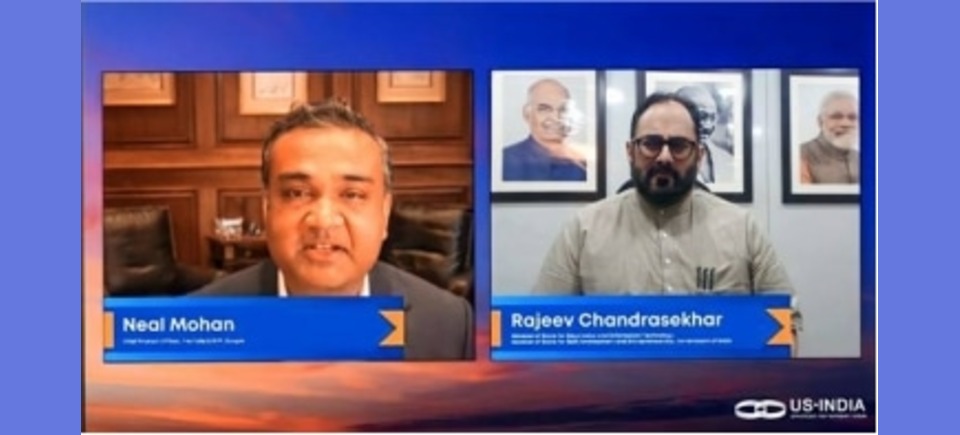
New Delhi: Rajeev Chandrasekhar, Minister of State for Electronics and Information Technology and Skill Development and Entrepreneurship addressed US- India Strategic Partnership Forum’s 4th Annual Leadership Summit on Thursday. The Summit, organized under the leadership of John Chambers, Chairman, USISPF and Dr. Mukesh Aghi, CEO & President, USISPF touched upon resilience in the face of adversity and strengthening the US-India strategic partnership through trade, commerce, diplomacy, technology and healthcare in the era of the Covid-19 pandemic.
During the virtual summit, Shri Chandrasekhar, apprised about the impact of COVID-19 on overall digital ecosystem in India. “One of the sectors that has grown at a galloping pace in the Indian economy is the tech space. Apart from the short-term setback during the first two quarters of the pandemic, the tech space has really taken off, and for a lot of people, there has been a reset of ambitions and plenty of people now see it as a world full of opportunities”, he said in his opening remarks. He also spoke about the Prime Minister’s vision on Digital India which clearly lays down that a) Technology has to be deployed in a way that it transforms & improves the lives of People b) Technology has to Quantitatively expand & Qualitatively improve the Economy c) Technology has to expand opportunities for Entrepreneurship, Jobs & Livelihood d) India has to attain leadership in some or all aspects of the emerging force – ‘Internet’.
The Minister credited the Digital India Programme for helping the Government reach out to the remotest parts of the country during the pandemic. “The resilience and the robustness at which the economy has bounced back, a lot of that has to do with the early investment that the Prime Minister made in Digital India in the earliest years of his administration and embedding technology into governance”, said Rajeev Chandrasekhar.
During the meeting, Shri Chandrasekhar also talked about Geo-Politics, ICT Trade, Data Governance and Cross-Border Data Flows.
Shri Rajeev Chandrasekhar highlighted the importance of collaboration in regulatory issues regarding new technologies, open internet, collaboration and data sharing among nations, in conversation with Neal Mohan, Chief Product Officer, Youtube and SVP Google.
Expanding into the need for collaboration between countries, the Minister highlighted that “the future of technology cannot be left to some dynamic of entrepreneurs and investors, it has to be driven proactively by four members of the Quad, who have open societies, democracies who can shape the future of technology, future of the internet – one that remains open, safe and trusted, and accountable. At the front and center of the conversation, there is a need for political understanding on the future of technology”.
“There is a significant behavioral change among citizens and the Government is catching up gradually. We are really reinventing our model, whether it’s skilling or creativity or producing content. This is a fact that disruption is deep and permanent. And I think this is the new normal that technology is creating new heroes every day, whether they’re unicorns in the tech space or content creators,” he concluded.
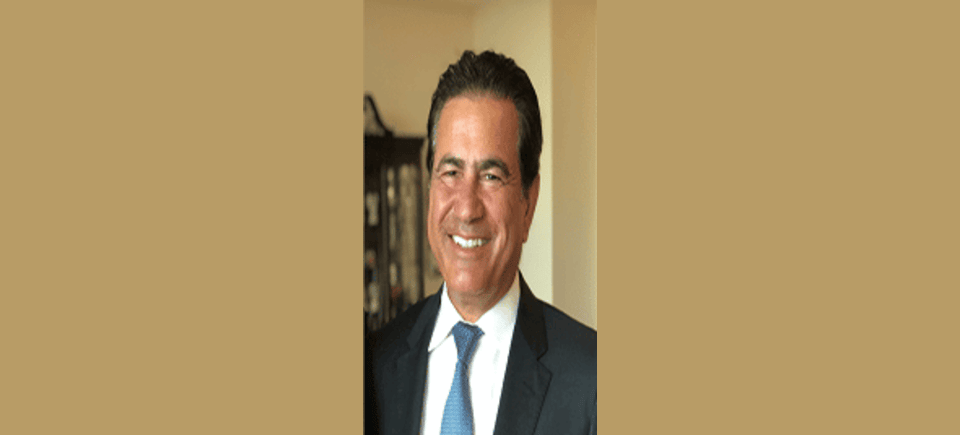
Dr. Mukesh Aghi has over 30 years’ experience leading complex operations at large global corporations, from enterprise software maker JD Edwards to IT giants IBM and Steria, across geographies as diverse as Japan, …
Source: Tycoon
Source Link: http://thetycoonmedia.com/dr-mukesh-aghi-president-ceo-at-us-india-strategic-partnership-forum/