US Business Welcomes Indian Envoy Taranjit Singh Sandhu's Extension

Categories
USISPF in the News

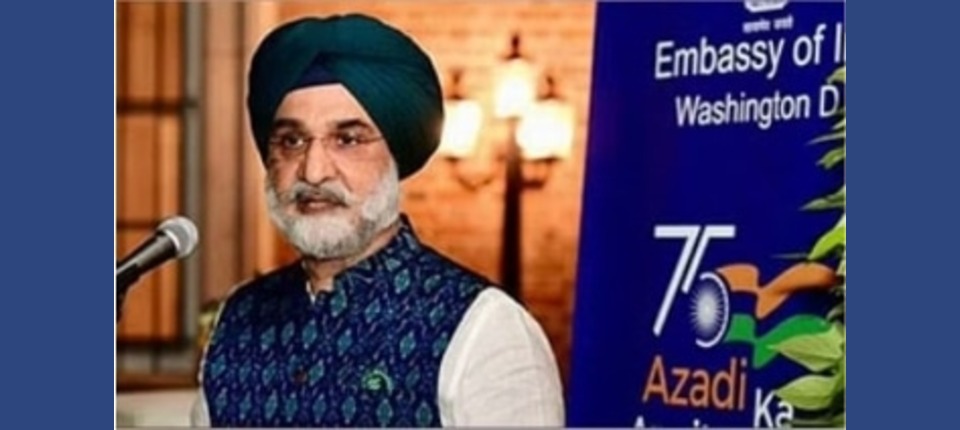
US business body welcomes extension of Indian envoy Taranjit Singh Sandhu

Washington [US], December 1 (ANI): After the Indian government extended Ambassador Taranjit Singh Sandhu’s tenure, a US-based business advocacy group, US-India Strategic Partnership Forum (USISPF) welcomed the decision and said that this would help in shepherding the relationship to new heights.

Mukesh Aghi, President and CEO of USISPF, said, “I congratulate Ambassador Sandhu on his extension till 2024. Apart from being a veteran of US-India relations, I am proud to say Ambassador Sandhu has also been a dear friend of USISPF and an exceptional asset to the US-India partnership, shepherding this relationship to new heights.”

“He has seen the evolution of the strategic partnership through his multiple years of experience in the US, from his earlier years in the foreign service in the late 90s to his stint as DCM and now as Ambassador in Washington. Ambassador Sandhu brings unparalleled expertise and experience in his interactions with both the legislature and executive branches of the US government. His extension will help consolidate US-India relations and take it to new heights,” he added.

Earlier, in November, a notification reads that Ambassador Taranjit Singh Sandhu is reemployed for a period of one year with effect from 01.02.2023 to 31.01.2024 or until further orders.

Earlier, in 2020, Taranjit Singh Sandhu took charge as the new Indian Ambassador to the United States from his predecessor Harsh Vardhan Shringla, who is now G20 chief coordinator.

Sandhu was, earlier, the High Commissioner of India to Sri Lanka. He previously served as the Deputy Chief of Mission at the Embassy of India in Washington DC from 2013 to 2017. The Ambassador had also previously served in the Indian mission in DC between 1997 to 2000 and is generally believed to be a familiar face in the Washington DC circle.

Official sources also told ANI that Sandhu’s appointment will be announced ‘soon’ in light of the possibility that US President Donald Trump is likely to visit India on a standalone visit towards the end of February.

The official also said that the procedures of the new appointee are also underway in Washington DC. 

More information
https://theprint.in/world/us-business-body-welcomes-extension-of-indian-envoy-taranjit-singh-sandhu/1243418/?amp

Categories
USISPF in the News

Views | G20 Presidency: Finest opportunity for India to showcase its strengths

By Mukesh Aghi

India has long espoused a multilateral world order where the key stakeholders need to reflect the evolution of the global economy over the past 70 years. The G20 agenda for 2023 focuses on numerous ideas and issues including climate financing, energy security, international development cooperation as well as inclusive, equitable, and sustainable growth.

Today, December 1, 2022, India formally takes over from Indonesia as G20 President. 

Prime Minister Modi’s message ahead of the next G20 Summit has been that India’s Presidency will be based on the importance of equitable growth and a shared future for all. 

The messaging was clear that “India’s G20 presidency is coming at a time of crisis and chaos in the world”, from the pandemic and conflicts and therefore, lotus,  the national flower of the country, is its symbol projecting peace and “Vasudhaiva Kutumbhakam” or “One Earth One Family One Future”. 

Certainly, the G20 bloc represents the 20 most powerful economies that contribute to around 80 percent of global GDP and over 75 percent of global trade. It started in 1999 with the aim of discussing policies in order to achieve international financial stability. But it wasn’t until the financial crisis of 2008 that the forum gained ground as a vehicle to address the global financial crisis. Since then, the G20 had its greatest significance in strengthening the global financial system, promoting economic cooperation, and preventing new global financial crises. Each year the host nation brings a unique perspective and touches on key policy issues.

India should use this august platform, to state its priorities for the region and the emerging market world. New Delhi has already outlined priorities pertaining to climate action, critical and emerging technologies, resilient supply chains, and vaccines, which still remain a priority until COVID-19 has been eradicated.

As the US Treasury Secretary Janet Yellen pointed out in her recent visit to India, India’s G20 Presidency in the upcoming year provides an extensive opportunity to further advance the bilateral partnership and to fulfill broader goals, as Washington throws its weight behind India, in its G20 Presidency. “Friendshoring” was the key term that the Secretary stated in the latest effort toward rebuilding supply chain resilience. 

India has long espoused a multilateral world order where the key stakeholders need to reflect the evolution of the global economy over the past 70 years. The G20 agenda for 2023 focuses on numerous ideas and issues including climate financing, energy security, international development cooperation as well as inclusive, equitable, and sustainable growth. New Delhi can strive towards building an inclusive ecosystem with holistic mechanisms to address key global issues for the private sector.

One of the key issues being digital transformation, as Prime Minister Modi echoed as the “most remarkable change” of this era, has been digitization- a key priority, where a digital economy is the key to inclusive growth and one that can uplift millions out of the morass of poverty. 

Prime Minister Modi stated “India will work jointly with G20 partners towards this objective”, referring to digitization. The principle of ‘data for development’ will be an integral part of the overall theme of our Presidency ‘One Earth, One Family, One Future”. Furthermore, digital solutions will also be helpful in the fight against climate change, as India, like the rest of the world, turned to remote-working and paperless green offices during the pandemic. 

Furthermore, this led to an uptick in digital sectors such as EdTech and MedTech. India will use the G20 platform to address joint research and development in climate finance and clean energy technologies, as India recently reiterated at COP 27 in Egypt.

As COP27 ended in Egypt, India reiterated that developing countries need independence in their choice of energy mix, to achieve sustainable development goals (SDG). India has maintained that developed countries need to take the lead in climate action.

Countries couldn’t agree to “phase down” all fossil fuels (not just coal), as India and most of the EU nations reiterated this to be included in the final decision to keep the 1.5-degree Celsius goal alive to limit global warming.

Under the wider theme of sustainability, the US and India can fulfil their bilateral goals and shared agenda under the auspices of the global G20 platform. With the present global order in a state of flux and the changing dynamics of the contemporary international system, India’s presidency assumes greater relevance, at a time when global economies are sluggish, and India is punching above its weight with nearly 7 percent economic growth.

Collective-action initiatives like the Mission LiFE movement (Lifestyle for the Environment) launched by Prime Minister Narendra Modi lead the way towards substantial opportunities for increasing global engagement, especially for countries in the Global South.

India’s G20 Presidency propels its role as an emerging leader in the global scenario, where New Delhi will focus on steering global engagement, growth, and development, environmental concerns, digital economy, and infrastructure in the emerging market. The leadership also gives a stronger voice to the challenges faced by the developing world as it leads the way with its increasingly growing economy. 

—Mukesh Aghi is the CEO & President of US- India Strategic Partnership Forum)

More information
https://www.cnbctv18.com/views/views-g20-presidency-finest-opportunity-for-india-to-showcase-its-strengths-15294791.htm

Categories
USISPF in the News

Celebrating 75 years of US-India Relations

Since India’s economic reforms of 1991, the country has emerged as an economic behemoth, a South Asian tiger and this has helped forge a close economic partnership with US.

The U.S.-India relationship has been dubbed as the most important strategic partnership of the 21st century. India’s economic reforms of 1991 and its emergence as South Asian tiger has helped forge closer economic partnership between our two countries.

By Mukesh Aghi

75 years is a milestone, a monumental one indeed.

This August, we celebrate India’s 75 years of independence, but simultaneously celebrate 75 years of relations between the United States and India.

The US-India relationship has been dubbed as the most important strategic partnership of the 21st century. I have witnessed how the relationship has moved beyond symbolic platitudes between the world’s oldest and largest democracy to robust engagements across trade, defence, climate and technology.

Our political relations may be long, but our economic synergy has been comparatively a shorter story. Since India’s economic reforms of 1991, the country has emerged as an economic behemoth, a South Asian tiger and this has helped forge a close economic partnership between our two countries. From my years in the private sector, particularly the technology sector, I have witnessed how American enterprises have leveraged India’s skilled workforce and burgeoning economic growth and tapped into the Indian market.

In a short period, the bilateral trade between India and the U.S. has crossed the $100 billion mark in 2021. According to official figures, the overall US-India bilateral trade in goods and services reached a record $157 billion, a drastic increase from the 2020 trade figures.

The economic importance of this relationship is well evinced. Washington’s trade with its top 15 partners has increased over the past year; the single biggest jump was with New Delhi in 2021, making India the eighth largest trading partner for the US. The Honorable Commerce and Industry Minister, Piyush Goyal at our Annual Leadership Summit has spoken about a milestone target of a trillion dollars in bilateral trade by the year 2030. For India, to achieve its target of a $ 5 trillion economy, the lion’s share of Foreign Direct Investments (FDI) will need to come from the world’s largest economy.

Our shared objectives, values, and vision lie in securing a free, open, and prosperous Indo-Pacific, adhering to a rules-based international order, and maintaining international security while upholding freedom of navigation. Furthermore, our joint-military engagement along with our Quad partners demonstrates the comprehensive strategic partnership, as we seek to align the Quad to work towards helping regions in the Indo-Pacific address the pernicious threat of climate change, vaccine delivery, and work to secure critical and emerging technologies.

In the Middle East, our mini-lateral cooperation in I2U2, along with Israel and the United Arab Emirates has prioritized our regional interests in the region in cyberspace, food, and energy security, as the conflict in Europe has highlighted the near-term shortcomings.

As we look towards a post-pandemic recovery, we are cognizant of how the pandemic has cost lives and wreaked economic havoc in our two countries. And yet in the new era of social distancing, our two countries have come closer in our vaccine cooperation as we seek to leverage India’s pharmaceutical manufacturing prowess and American logistics to ensure the delivery of safe and cost-affordable vaccines to countries in need.

Our goal is forward-looking and for posterity’s sake, the Quad fellowship seeks to nurture the next generation of scientists as we prioritize education through shared values. The relationship has had its ebbs and flows through the first fifty years to the now robust edifice of strong diplomatic ties that it now rests on.

This relationship is much bigger than government-to-government relations. Its strength lies in the partnership between two kindred spirits. What makes this partnership truly special is an unwavering commitment to democratic values and a mutual affinity that the people share for each other. The story is one of the shared democratic values, codified in both constitutions but above all the power of the populace and hence we believe that the real catalyst to this strategic partnership is the story of the Diaspora, who have helped fructify this colossal partnership of 75 years.

While we look back and celebrate the past 75 years, I am excited about what the future holds for our two economies as we work together to build stronger bonds, strengthen commercial ties, and tackle challenges such as the COVID-19 pandemic and climate change.

So, this August, on behalf of everyone at the US-India Strategic Partnership Forum (USISPF), I wish all my fellow Indian citizens and the diaspora across the world, a very Happy Independence Day.

The author is the CEO  & President of US- India Strategic Partnership Forum

More information
https://www.financialexpress.com/defence/celebrating-75-years-of-us-india-relations/2633854/

Categories
USISPF in the News

The Ukraine crisis and the supply chain conundrum

By Dr Mukesh Aghi and Colonel Baljinder Singh (retd)

The conflict in Ukraine is well into its fourth month, the Russian ground and aerial and ground assault continues to bombard Ukrainian cities. The ripple effects have been pervasive beyond just Ukraine and European security.

At stake, is a supply chain crisis that has barely recovered since the COVID-19 pandemic. The implications for India are substantial and extend to how Indian leaders should manage the defense and national security enterprise.

After UkraineWar: A World of Change

India, with its large consumer demand has just started to see a COVID recovery with a demand uptick. Russia’s increased aggression on its western neighbour has catastrophically escalated oil prices to an energy crisis and critical shortages in food, grain, fertilizer, and chemicals.

Russia and Ukraine are both significant players in global energy, food grains and the fertilizer markets. Russia is the world’s third largest producer and exporter of oil; the second largest producer and the largest exporter of natural gas; and the third largest exporter of coal. Russia is also the world’s single largest exporter of wheat and the second largest exporter of sunflower oil and largest exporter of fertilizers overall.

Ukraine is also significant to global food markets, as the largest exporter of sunflower oil, the fourth largest exporter of maize and the fifth largest exporter of wheat.

Ukraine also provides about one-half of the world’s supplies of neon gas, – required for high-precision laser equipment used to manufacture microchips. Furthermore, Russia provided a large share of U.S. supplies of palladium, used in semiconductors and catalytic converters. U.S. sanctions on Russia, combined with continued war and deliberate sabotage of critical assets by warring forces, have resulted in immediate and significant disruption to supply chains and the movement of goods from the Black Sea and Sea of Azov to the world.

Impact on India’s Economy and Security

The ripple effects like a tsunami have hit Indian shores. The country’s soaring inflation rate led the Reserve Bank of India (RBI) to increase the repo rate for the first time since the COVID-19 pandemic with the most recent 50-basis point increase earlier in June. The Indian government has raised the prices of fuel, with the RBI estimating a growth forecast of nearly 7% (6.9%,)likely to become lower if global disruptions continue.

India is a net commodity importer and has witnessed an incremental increase in the cost of edible oils, combined with rising costs of importing crude oil. Prices of commodities like sunflower oil, a staple for Indians, have spiralled. The surge in fuel prices has impacted the price of food items, especially perishable items, exacerbated by increased logistic costs. Shipping costs are crushing small and medium enterprises in particular.

In the defence sector, pending equipment purchases and maintenance, repair, and operation of equipment (MRO) are of critical concern. More than 70 percent of the equipment used by the Indian armed forces is of erstwhile Soviet origin and India is heavily dependent on Russia for the supply of spare parts and components to keep the fleet functional. Plans for upgrading 86 Sukhoi fighters for $47 billion had to be shelved due to unavailability of semiconductors and other parts. The Ministry of Defence is also concerned about disruptions in supply of spares from both Ukraine and Russia, particularly for several tanks and missile systems currently being used by the Indian Army and for gas turbine engines used by several Indian Navy warships.

Another major effect is the delay in rolling out the S-400 Air Defence Missile System, which India had procured from Russia. The delivery of the system had begun in December 2021. India needs these weapon systems as it continues to face a military challenge from China along its disputed Line of Actual Control (LAC). The Indian government is concerned about the possibility of Chinese encroachment and the fraught geopolitical situation triggered by the conflict in Ukraine. Hence New Delhi is stepping up its infrastructure and militarization of the disputed areas.

Russia has come under a wave of sanctions, namely ousted from the international banking system, SWIFT, and hence this will affect impending payments for the S-400. The joint project to manufacture AK 203 rifles in India will likely be delayed, despite bureaucratic formalities completed.

First the pandemic and now Putin’s consequentes have halted global recovery. The longer the war, the more pronounced the effects. Though the Indian economy is resilient and recovering, it isn’t immune, and the importance of diversification, including continuing investment in self-reliance through Atma-NirbharBharat and indigenization of the defense industry.

As far as defence is concerned, India must diversify weapon purchases from global suppliers with terms that include technology transfer and domestic manufacturing through joint ventures. India should also work with partners to rapidly indigenize spares and sub-systems for Russian-origin equipment, taking over the MRO of these systems and reducing reliance on Russia which will be a more unreliable source due to its own needs to recapitalize and the complications of global sanctions. Over the next few years, India may be able to provide MRO for Russian-origin systems to nations, such as Vietnam, who also possess large inventories of Russian material.

Prime Minister Modi has made clear that Atma-Nirbhar Bharat does not mean India alone and now is the time to think out of the box about how Indian self-reliance can contribute to global resilience.

Partners like the United States, European Union (EU), Israel, Japan and Australia can coalesce in this effort as long as we structure major defence procurements that attract international investment and simultaneously build India’s defense and technology ecosystem.

(Dr Mukesh Aghi is the CEO & President and Colonel Baljinder Singh is Director Aerospace and Defence at US- India Strategic Partnership Forum. Views expressed are personal and do not reflect the official position or policy of Financial Express Online. Reproducing this content without permission is prohibited).

More information
https://www.financialexpress.com/world-news/the-ukraine-crisis-and-the-supply-chain-conundrum/2579599/

Categories
USISPF in the News

Honor Warburg Pincus CEO Chip Kaye, and ReNew Founder and CEO Sumant Sinha With 2022

(Eds: Disclaimer: The following press release comes to you under an arrangement with Business Wire India. PTI takes no editorial responsibility for the same.)
New Delhi, Delhi, India & Washington, D.C., United States – Business Wire India

The US-India Strategic Partnership Forum (USISPF) announced the dates for its 2022 Annual Leadership Summit, “Celebrating 75 Years of U.S.-India Partnership”. The program will convene in a hybrid format the week of July 18, 2022.

This year, USISPF will recognize Chip Kaye, the CEO of Warburg Pincus, and Sumant Sinha, the Founder, Chairman and CEO of ReNew Power with the Global Leadership Award 2022 for their exceptional leadership in global financial investments and renewable energy projects in India.

Congratulating the awardees, John Chambers, Chairman of the USISPF Board, said, “This year, we honor two USISPF Board Members for their contributions to strengthening business ties between the U.S. and India. Chip and Sumant have been tireless advocates for a more vital U.S.-India economic partnership and we are grateful for their leadership on our Board.”

Mukesh Aghi, President and CEO of USISPF said, “It was Chip who led Warburg Pincus’s investment in Bharti Airtel over two decades back that paved the way through for global private equity firms to start looking at India, and Sumant has emerged as a leader in the new and renewable energy industry. ReNew has already done a lot of work for a sustainable future. Sumant built Renew as an entrepreneur, instilled world-class governance, and providing leading U.S. investors in the first opportunity to invest in Indian renewables and educating global stakeholders in the India opportunity along the way. We are honored to present these two leaders with the 2022 USISPF Global Leadership Awards.”

Chip Kaye has led Warburg Pincus for the past two decades, including during the firm’s expansion into Asia. Under Chip Kaye’s leadership, Warburg Pincus opened their first Asia office in 1994, paving the way for other global private equity firms to enter the region.

Accepting this award, he said, “I share my gratitude for this meaningful recognition with my Warburg Pincus India colleagues who, for more than 25 years, have played a growth catalyst role by partnering with innovative companies in the region. We appreciate our long-standing relationships with Indian entrepreneurs and look forward to continuing to partner with talented management teams to build valuable, sustainable companies.”

Sumant Sinha founded ReNew Power in 2011 and has grown it to become India’s largest renewable energy company. ReNew now generates almost 2% of India’s total electricity annually, and in doing so helps mitigate half a per cent of India’s carbon emissions in a year.

Acknowledging the award, Sumant said, “I am deeply honored and humbled to accept the USISPF 2022 Leadership Award. This recognition is made more meaningful as it comes at a time when businesses in both the U.S. and India are increasing collaboration across sectors; with a focus on innovation, the clean energy transition, fighting climate change, sustainability, and green supply chains. Both countries share similar democratic values and foster a culture of collaboration, inclusion, diversity, innovation and of not accepting the status quo. I am proud that, as chairman of ReNew Power, I have had the opportunity and privilege to contribute to deepening business and economic ties between both nations.”

This year, USISPF for the first time will also give the Distinguished Services Award for contributions to strengthening defense ties between the U.S. and India. The honorees will be General James Mattis, U.S. Marine Corps (Ret.), Former U.S. Secretary of Defense, Davies Family Distinguished Fellow, Hoover Institution, and General Manoj Mukund Naravane, Former Chief of Army Staff, Indian Army. During his time as Secretary of Defense, General Mattis took India to new heights as a strategic partner with the United States and emphasized a commitment to shared values of a safe and secure, prosperous, and free Indo-Pacific. During his time as Chief of Staff of the Indian Army, General Naravane helped to modernize the Indian army, along with improving defense partnerships and growing interoperability between the U.S. and India. USISPF is honored to celebrate these two individuals for their significant contributions to the U.S.-India defense relationship.

The awards ceremony will be part of a hybrid event taking place in Washington D.C. on July 21. The ceremony will be followed by a panel discussion with the honorees.

About the U.S.-India Strategic Partnership Forum (USISPF)

The US-India Strategic Partnership Forum (USISPF) is committed to creating the most powerful partnership between the United States and India. As the only independent not-for-profit institution dedicated to strengthening the U.S.-India partnership in Washington, D.C. and in New Delhi, USISPF is the trusted partner for businesses, non-profit organizations, the diaspora, and the governments of India and the United States.

More information
https://www.theweek.in/wire-updates/business/2022/06/21/pwr21-u.s.-india-strategic-partnership-forum–usispf.html

Categories
USISPF in the News

USISPF to Honor Warburg Pincus CEO Chip Kaye, and ReNew Founder

Washington, D.C., United States & New Delhi, Delhi, India: 

The US-India Strategic Partnership Forum (USISPF) announced the dates for its 2022 Annual Leadership Summit, “Celebrating 75 Years of U.S.-India Partnership”. The program will convene in a hybrid format the week of July 18, 2022.

This year, USISPF will recognize Chip Kaye, the CEO of Warburg Pincus, and Sumant Sinha, the Founder, Chairman and CEO of ReNew Power with the Global Leadership Award 2022 for their exceptional leadership in global financial investments and renewable energy projects in India.

Congratulating the awardees, John Chambers, Chairman of the USISPF Board, said, “This year, we honor two USISPF Board Members for their contributions to strengthening business ties between the U.S. and India. Chip and Sumant have been tireless advocates for a more vital U.S.-India economic partnership and we are grateful for their leadership on our Board.”

Mukesh Aghi, President and CEO of USISPF said, “It was Chip who led Warburg Pincus’s investment in Bharti Airtel over two decades back that paved the way through for global private equity firms to start looking at India, and Sumant has emerged as a leader in the new and renewable energy industry. ReNew has already done a lot of work for a sustainable future. Sumant built Renew as an entrepreneur, instilled world-class governance, and providing leading U.S. investors in the first opportunity to invest in Indian renewables and educating global stakeholders in the India opportunity along the way. We are honored to present these two leaders with the 2022 USISPF Global Leadership Awards.”

Chip Kaye has led Warburg Pincus for the past two decades, including during the firm’s expansion into Asia. Under Chip Kaye’s leadership, Warburg Pincus opened their first Asia office in 1994, paving the way for other global private equity firms to enter the region. 

Accepting this award, he said, “I share my gratitude for this meaningful recognition with my Warburg Pincus India colleagues who, for more than 25 years, have played a growth catalyst role by partnering with innovative companies in the region. We appreciate our long-standing relationships with Indian entrepreneurs and look forward to continuing to partner with talented management teams to build valuable, sustainable companies.”

Sumant Sinha founded ReNew Power in 2011 and has grown it to become India’s largest renewable energy company. ReNew now generates almost 2% of India’s total electricity annually, and in doing so helps mitigate half a per cent of India’s carbon emissions in a year. 

Acknowledging the award, Sumant said, “I am deeply honored and humbled to accept the USISPF 2022 Leadership Award. This recognition is made more meaningful as it comes at a time when businesses in both the U.S. and India are increasing collaboration across sectors; with a focus on innovation, the clean energy transition, fighting climate change, sustainability, and green supply chains. Both countries share similar democratic values and foster a culture of collaboration, inclusion, diversity, innovation and of not accepting the status quo. I am proud that, as chairman of ReNew Power, I have had the opportunity and privilege to contribute to deepening business and economic ties between both nations.”

This year, USISPF for the first time will also give the Distinguished Services Award for contributions to strengthening defense ties between the U.S. and India. The honorees will be General James Mattis, U.S. Marine Corps (Ret.), Former U.S. Secretary of Defense, Davies Family Distinguished Fellow, Hoover Institution, and General Manoj Mukund Naravane, Former Chief of Army Staff, Indian Army. During his time as Secretary of Defense, General Mattis took India to new heights as a strategic partner with the United States and emphasized a commitment to shared values of a safe and secure, prosperous, and free Indo-Pacific. During his time as Chief of Staff of the Indian Army, General Naravane helped to modernize the Indian army, along with improving defense partnerships and growing interoperability between the U.S. and India. USISPF is honored to celebrate these two individuals for their significant contributions to the U.S.-India defense relationship. 

The awards ceremony will be part of a hybrid event taking place in Washington D.C. on July 21. The ceremony will be followed by a panel discussion with the honorees. 

About the U.S.-India Strategic Partnership Forum (USISPF)

The US-India Strategic Partnership Forum (USISPF) is committed to creating the most powerful partnership between the United States and India. As the only independent not-for-profit institution dedicated to strengthening the U.S.-India partnership in Washington, D.C. and in New Delhi, USISPF is the trusted partner for businesses, non-profit organizations, the diaspora, and the governments of India and the United States. 

More information
https://www.businesswireindia.com/us-india-strategic-partnership-forum-to-honor-warburg-pincus-ceo-chip-kaye-and-renew-founder-and-ceo-sumant-sinha-with-2022-global-leadership-award-79423.html

Categories
USISPF in the News

India needs to adopt aggressive approach to attract businesses: USISPF

India must adopt an “aggressive approach” to attract multinational corporations to set up and expand their bases in the country, a top Indian-American business advocacy group has said, observing the ongoing Russia-Ukraine war is leading to a tectonic shift in global trade.

“I think India has to play a much more aggressive approach to these corporations. Having a direct dialogue with these corporations and tells them: ‘what do you need’, ‘what can be done for you to come invest in India?’” Mukesh Aghi, president, US-India Strategic and Partnership Forum (USISPF) told PTI in an interview.

Every corporation has a unique requirement, he said.

“Yes, you can’t change the law. But you can define a broad-based policy, which makes it attractive for a lot of these companies to come into India. That’s where India has to reach out to these companies, understand the requirements and then put in place a set of policies which become uniform,” he said.

Aghi said there have been some efforts but those are more of a transactional effort rather than a uniform or a cohesive approach on this.

Aghi said at some point of time India will need to think about its relationship with Russia.

He pointed out when US President Joe Biden was meeting Prime Minister Narendra Modi in Tokyo as part of the Quad summit this week, the Russian and Chinese governments were flying long-range bombers over the Sea of Japan.

“The message was very clear from Russia, that its partner, and his allegiance lies with China and the Indo-Pacific region, rather than India. And to me, it was very stark, that while the Prime Minister of India is there, you have Russian bombers threatening or taking a threatening posture along with the Chinese. To me that’s a very clear message that India has to start thinking about its position with Russia,” he said.

In response to the over two-month-long Russia-Ukraine war, India has called for respect of territorial integrity of nations and the United Nations Charter.

However, New Delhi has not condemned Russia directly.

“The question really becomes: at what stage India will come out and condemn it. I think India as an emerging power has to start taking some positions, which may upset other nations, but that’s the nature of the beast when you are becoming a leading power,” Aghi said.

One thing that has come out clearly from the Ukraine war is that Russian equipment has not performed well, he said.

“Russian Defense Forces and the equipment have been destroyed substantially. Russia’s economic embargo means chips and semiconductors are not moving into Russia. So, Russia will have difficulty providing spare parts not only for his own armed forces, but for countries like India, he said.

“So India has to seriously start thinking what are the alternatives. At the end of the day, India’s biggest challenge is China, not Russia. And we’ve had in the last two years, physical invasion and killing by Chinese and Indian soldiers. That’s where the bigger enemy lies. India has to look at its supply side; this defense strategy from that perspective – as Russia gets weaker both from a supply chain perspective and also as a military problem? Aghi said.

According to Aghi, the Russian invasion of Ukraine has changed in some way the global order, especially the balance of power. We are seeing tectonic shifts taking place, he said.

“Corporate America got weaponised by having to pull out of Russia overnight, and that was not a diktat from the US government. It was a consumer sentiment which drove that decision making. There’s a tremendous amount of empathy for Ukraine and that influences boardroom thinking about being or not to be within Russia and the majority of the companies have pulled out of Russia, he said.

Now the question you have is among the boardroom discussion taking place is what happens if China invades Taiwan then what happens to our investments in China? More important is what is our backup strategy? Yes, you can bring back a lot of stuff manufacturing to the United States, but a lot of them won’t come in because of lack of resources, lack of manpower, he said.

And that’s where India becomes a critical player, both from a market perspective and also from a manufacturing perspective. I think that’s where you need to leverage all of India’s attractive market for these companies to come in and start having a China response strategy as things move forward, Aghi said.

More information
https://www.business-standard.com/article/current-affairs/india-needs-to-adopt-aggressive-approach-to-attract-businesses-usispf-122052700060_1.html

Categories
USISPF in the News

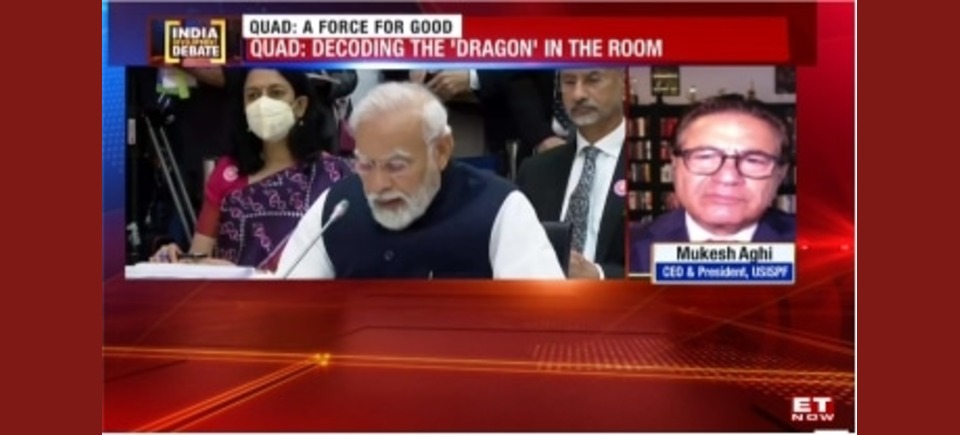
Quad: Decoding The ‘Dragon’ In The Room | India Development Debate

From peace and stability to global health security, read the joint statement by the leaders of India, Australia, Japan and the US at the Quad Summit 2022. The Quad leaders emphasised the need to address climate change and make robust arrangements for cybersecurity while harnessing critical and emerging technologies to ensure prosperity. Another key focus area was the peaceful resolution of disputes and the freedom of navigation in the East and South China Seas. In what may be considered an act of aggression, Chinese H-6K bombers and Russian Tu-95MS bombers conducted joint sorties above the Sea of Japan even while the Quad leaders were in Tokyo. We break down the key takeaways from the crucial summit and decode the ‘dragon’ in the room on the India Development Debate with Ambassador Leela K Ponappa, former career diplomat & former Dy NSA, Nalin Surie, former High Commissioner To UK and Mukesh Aghi, CEO & President, USISPF.

More information
https://www.timesnownews.com/videos/et-now/shows/quad-decoding-the-dragon-in-the-room-india-development-debate-et-now-video-91773382

Categories
USISPF in the News

Advance US-India Ties Through Trusted Technology

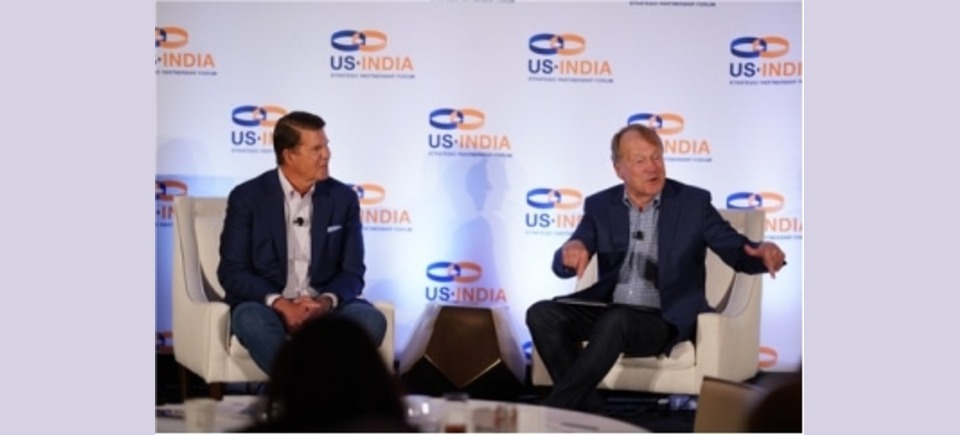
Keith Krach (left) and John Chambers discuss the critical role trusted technology plays in advancing freedom at the US-India Strategic Partnership Forum West Coast Summit.

MENLO PARK, Calif.–(BUSINESS WIRE)–Keith Krach, Chairman of the Krach Institute for Tech Diplomacy at Purdue, and John Chambers, Chairman Emeritus of Cisco, discussed the critical role trusted technology plays in advancing freedom at the US-India Strategic Partnership Forum (USISPF) West Coast Summit. As the only independent institution dedicated to strengthening the U.S.-India partnership in Washington, DC, MENLO PARK, Calif.–(BUSINESS WIRE)–Keith Krach, Chairman of the Krach Institute for Tech Diplomacy at Purdue, and John Chambers, Chairman Emeritus of Cisco, discussed the critical role trusted technology plays in advancing freedom at the US-India Strategic Partnership Forum (USISPF) West Coast Summit. As the only independent institution dedicated to strengthening the U.S.-India partnership in Washington, DC, and New Delhi, USISPF is the trusted partner for businesses, non-profit organizations, diaspora, and the governments of India and the United States.

“I have worked for Keith Krach at Ariba and now with John Chambers at USISPF,” said the organization’s President and CEO Mukesh Aghi. “They are both true champions of a strong U.S.-India relationship and have done much in their careers to strengthen ties between our two nations.”

“As I think about the influences that have been most important to me over the years, my friend and mentor John Chambers stands out,” observed Keith Krach. “His visionary leadership of one of the world’s most important companies, Cisco, has changed the technology industry, and, in his role as the USISPF Chairman, John’s focus on promoting entrepreneurship, gender equality, and new business creation will continue to improve the lives of people in the U.S., India, and around the world.”

“Keith is one of this generation’s premier multi-sector transformational leaders, as he has proven repeatedly in business, philanthropy, tech, education, and government,” said John Chambers before the USISPF gathering of government and business leaders. “The common thread through all these transformational achievements is Keith’s emphasis on trust. As the Under Secretary of State, Keith was able to accomplish things that have not been done before by deploying his underlying “Trust Principle” doctrine and creating Tech Statecraft, for which he has been recognized with a 2022 Nobel Peace Prize nomination.”

Krach explained that the “Trust Principle” is based on democratic values, such as respect for the rule of law, sovereignty of nations, human rights, labor practices, press freedom, and the environment, as a peaceful alternative to authoritarian regimes’ “Power Principle” doctrine, rooted in brute force, coercion, and intimidation.

Krach described how, as the world was struggling through the worst pandemic in a century, his hybrid public servant-private sector executive team at the State Department put the “Trust Principle” to the test by taking on the Chinese Communist Party’s masterplan to control 5G. The concept resonated globally, as indicated by the success of the Clean Network, which attracted 60 countries, representing two-thirds of the world’s GDP, and more than 200 telecommunications companies rallying around the “Trust Principle.” It also put the Chinese government on notice that its “Power Principle” would no longer go unchallenged.

During their dialogue, Chambers also pointed to Krach as a champion of the U.S. high tech industry, citing his team’s lead role in the onshoring of Taiwan Semiconductor Manufacturing Company (TSMC), which has led to $300 billion investment in the U.S.-based chip manufacturing, and the design of the $250 billion bipartisan U.S. Innovation and Competition Act (USICA), which will fund research in top national security technologies in order to secure America’s high tech leadership for the next generation.

Shifting to the lessons of the war in Ukraine, Chambers brought up Krach’s Fortune article, Present your China contingency plan at the next board meeting, which highlighted the fact that many of the most respected board members in corporate America are demanding a China contingency plan from their CEOs. “​​What if Xi pulls a Putin?” Krach asked the USISPF attendees. “​​With Xi’s recent crackdown on private industry and the real probability of an attack on Taiwan, boards increasingly understand doing business with, in, or for China represents tremendous risk. Board members have a fiduciary duty to the shareholders to mitigate significant risks.”

The USISPF discussion concluded with the focus on deepening partnerships between the United States and India as an important aspect of the Krach Institute for Tech Diplomacy. “Democracy is under attack like never before and our two nations’ are the world’s largest democracies. Preserving freedom and peace through trust must be at the heart of our relationship” Krach said, “As one of America’s closest friends, a technological superpower, and a member of the Quad and the Clean Network Alliance of Democracies, India is not only a bulwark against techno-authoritarianism, but also crucial to advancing our shared democratic values through trusted technology.”

About the Krach Institute for Tech Diplomacy at Purdue:

The nonpartisan Krach Institute for Tech Diplomacy at Purdue is the world’s preeminent institution focused on Tech Statecraft, a new model of diplomacy that bridges the high-tech sector with the foreign policy and national security sectors to ensure trusted technology is used to advance freedom.​ The Krach Institute for Tech Diplomacy is a 501(c)(3) that leverages Purdue’s strength in innovation, deep expertise in technology, and global prowess in educating transformational leaders. It focuses on rallying our allies, leveraging the innovation of the private sector, and amplifying democratic values based on trust.

More information
https://www.businesswire.com/news/home/20220512006044/en/Keith-Krach-and-John-Chambers-Advance-US-India-Ties-Through-Trusted-Technology

Categories
USISPF in the News

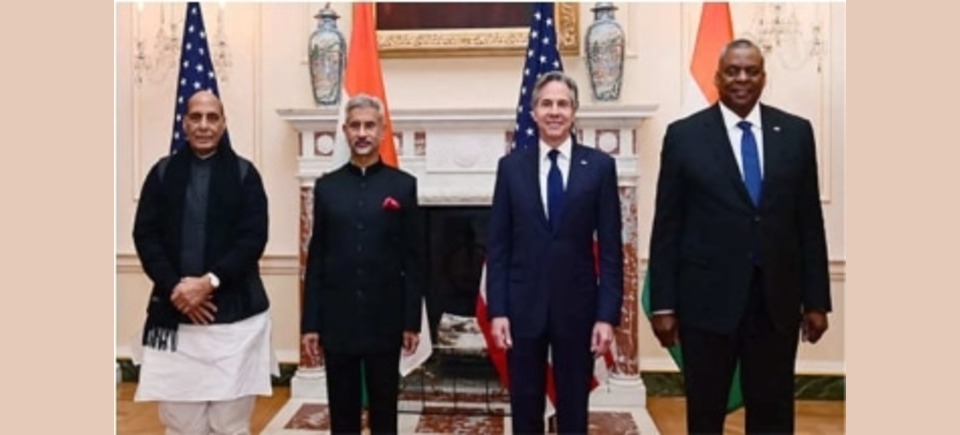
2+2 ministerial dialogue outlined path forward to continue building on the ambitious course

“The 2+2 Ministerial Dialogue outlined the path forward to continue building on the ambitious course in the US-India partnership and touched on the secret sauce of this relationship – the importance of people-to-people ties,” Mukesh Aghi, president of US India Strategic and Partnership Forum (USISPF) said.

President Biden and Prime Minister Modi will now look forward to continuing the conversation in May at the next Quad Principal’s meeting in Tokyo, Japan, he said a day after the first virtual bilateral meeting between the two leaders along with the fourth India-US 2+2 dialogue.

The talks reiterated and reaffirmed the strength and robustness of the bilateral partnership.

Washington has made abundantly clear that New Delhi is a key partner in helping secure a “free, open and prosperous Indo-Pacific” as both President Biden and Prime Minister Modi discussed the important aspects of bilateral and global significance, he said.

“Most importantly, both leaders touched on the worrying humanitarian situation with the conflict in Ukraine, as Prime Minister Modi reiterated that diplomacy and dialogue between Ukraine and Russia was essential to ending this conflict,” Aghi said.

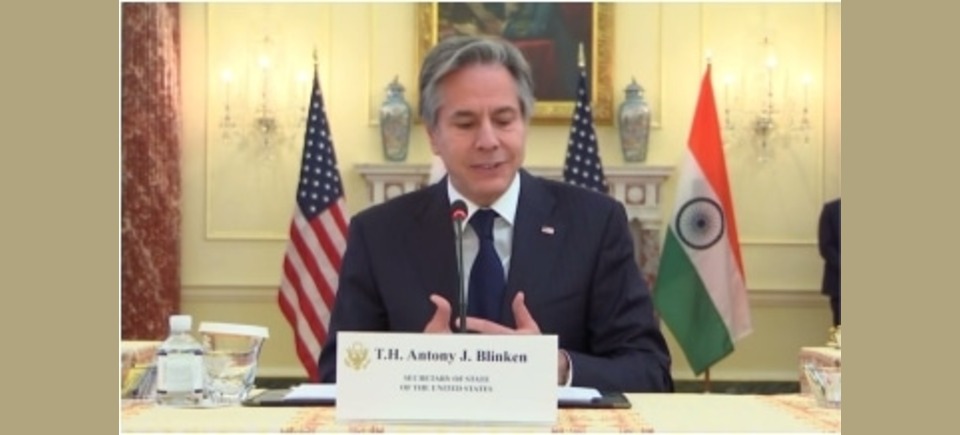
External Affairs Minister, S Jaishankar, Defence Minister Rajnath Singh and their counterparts, Secretary of State, Antony Blinken and Secretary of Defense, Lloyd Austin reiterated their respective leaders’ commitment and efforts in the global fight against the COVID-19 pandemic, the urgency of climate action, strengthening resilient supply chains disrupted by the pandemic and the Indo-Pacific Economic Framework and infrastructure, he said.

According to Aghi, this 2+2, like the past editions, touched on key science and technology partnership initiatives and new domains of cooperation in space and cyber and emerging technologies.

The foreign and defense principles outlined the importance of counterterrorism, operationalising the Major Defense Partnership and multilateral co-operation under the Quad umbrella, he noted.

Aghi said the dialogues epitomised the burgeoning military to military cooperation and joint-exercises between the armed forces of both nations as both sides reaffirmed their common strategic interests and an abiding commitment to the rules-based international order, touching on the Indian Ocean region to East and Southeast Asia and Europe.

“Both President Biden and Prime Minister Modi outlined their concern on the food supply shortages arising from the conflict and agreed to maintain close consultations on the ongoing crisis in Ukraine, including on humanitarian assistance efforts, and condemned the loss of civilian life,” he said.

More information
https://m.economictimes.com/news/india/22-ministerial-dialogue-outlined-path-forward-to-continue-building-on-the-ambitious-course-in-india-us-partnership-usispf/amp_articleshow/90806157.cms

Categories
USISPF in the News

2+2 ministerial dialogue outlined path forward to continue building

“The 2+2 Ministerial Dialogue outlined the path forward to continue building on the ambitious course in the US-India partnership and touched on the secret sauce of this relationship – the importance of people-to-people ties,” Mukesh Aghi, president of US India Strategic and Partnership Forum (USISPF) said.

President Biden and Prime Minister Modi will now look forward to continuing the conversation in May at the next Quad Principal’s meeting in Tokyo, Japan, he said a day after the first virtual bilateral meeting between the two leaders along with the fourth India-US 2+2 dialogue.

The talks reiterated and reaffirmed the strength and robustness of the bilateral partnership.

Washington has made abundantly clear that New Delhi is a key partner in helping secure a “free, open and prosperous Indo-Pacific” as both President Biden and Prime Minister Modi discussed the important aspects of bilateral and global significance, he said.

“Most importantly, both leaders touched on the worrying humanitarian situation with the conflict in Ukraine, as Prime Minister Modi reiterated that diplomacy and dialogue between Ukraine and Russia was essential to ending this conflict,” Aghi said.

External Affairs Minister, S Jaishankar, Defence Minister Rajnath Singh and their counterparts, Secretary of State, Antony Blinken and Secretary of Defense, Lloyd Austin reiterated their respective leaders’ commitment and efforts in the global fight against the COVID-19 pandemic, the urgency of climate action, strengthening resilient supply chains disrupted by the pandemic and the Indo-Pacific Economic Framework and infrastructure, he said.

According to Aghi, this 2+2, like the past editions, touched on key science and technology partnership initiatives and new domains of cooperation in space and cyber and emerging technologies.

The foreign and defense principles outlined the importance of counterterrorism, operationalising the Major Defense Partnership and multilateral co-operation under the Quad umbrella, he noted.

Aghi said the dialogues epitomised the burgeoning military to military cooperation and joint-exercises between the armed forces of both nations as both sides reaffirmed their common strategic interests and an abiding commitment to the rules-based international order, touching on the Indian Ocean region to East and Southeast Asia and Europe.

“Both President Biden and Prime Minister Modi outlined their concern on the food supply shortages arising from the conflict and agreed to maintain close consultations on the ongoing crisis in Ukraine, including on humanitarian assistance efforts, and condemned the loss of civilian life,” he said.

More information
https://timesofindia.indiatimes.com/india/22-ministerial-dialogue-outlined-path-forward-to-continue-building-on-the-ambitious-course-in-india-us-partnership-usispf/articleshow/90806311.cms

Categories
USISPF in the News

2+2 ministerial dialogue outlined path forward to continue building on the ambitious course

“The 2+2 Ministerial Dialogue outlined the path forward to continue building on the ambitious course in the US-India partnership and touched on the secret sauce of this relationship – the importance of people-to-people ties,” Mukesh Aghi, president of US India Strategic and Partnership Forum (USISPF) said.

President Biden and Prime Minister Modi will now look forward to continuing the conversation in May at the next Quad Principal’s meeting in Tokyo, Japan, he said a day after the first virtual bilateral meeting between the two leaders along with the fourth India-US 2+2 dialogue.

The talks reiterated and reaffirmed the strength and robustness of the bilateral partnership.

Washington has made abundantly clear that New Delhi is a key partner in helping secure a “free, open and prosperous Indo-Pacific” as both President Biden and Prime Minister Modi discussed the important aspects of bilateral and global significance, he said.

“Most importantly, both leaders touched on the worrying humanitarian situation with the conflict in Ukraine, as Prime Minister Modi reiterated that diplomacy and dialogue between Ukraine and Russia was essential to ending this conflict,” Aghi said.

External Affairs Minister, S Jaishankar, Defence Minister Rajnath Singh and their counterparts, Secretary of State, Antony Blinken and Secretary of Defense, Lloyd Austin reiterated their respective leaders’ commitment and efforts in the global fight against the COVID-19 pandemic, the urgency of climate action, strengthening resilient supply chains disrupted by the pandemic and the Indo-Pacific Economic Framework and infrastructure, he said.

According to Aghi, this 2+2, like the past editions, touched on key science and technology partnership initiatives and new domains of cooperation in space and cyber and emerging technologies.

The foreign and defense principles outlined the importance of counterterrorism, operationalising the Major Defense Partnership and multilateral co-operation under the Quad umbrella, he noted.

Aghi said the dialogues epitomised the burgeoning military to military cooperation and joint-exercises between the armed forces of both nations as both sides reaffirmed their common strategic interests and an abiding commitment to the rules-based international order, touching on the Indian Ocean region to East and Southeast Asia and Europe.

“Both President Biden and Prime Minister Modi outlined their concern on the food supply shortages arising from the conflict and agreed to maintain close consultations on the ongoing crisis in Ukraine, including on humanitarian assistance efforts, and condemned the loss of civilian life,” he said.

More information
https://www.devdiscourse.com/article/law-order/2001074-22-ministerial-dialogue-outlined-path-forward-to-continue-building-on-the-ambitious-course-in-india-us-partnership-usispf

Categories
USISPF in the News

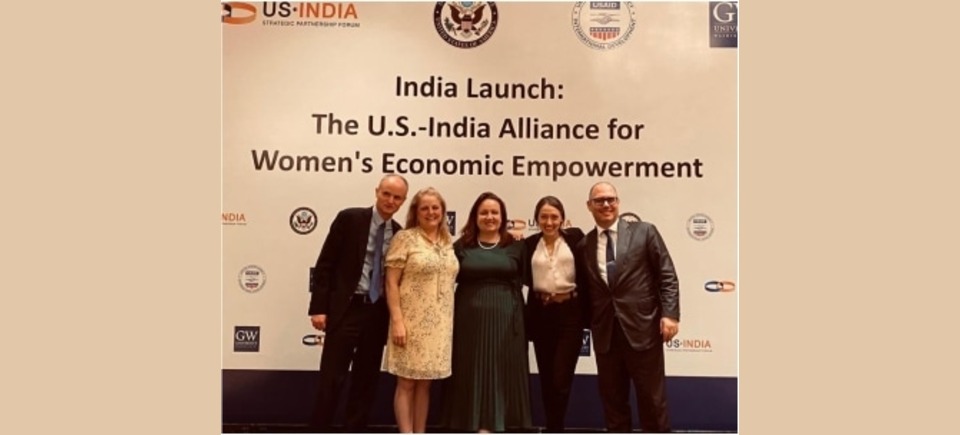
U.S.-India Alliance for Women’s Economic Empowerment Launches in New Delhi

Today, the U.S.-India Strategic Partnership Forum (USISPF), the U.S. Department of State, the U.S. Agency for International Development (USAID), and George Washington University launched the U.S.-India Alliance for Women’s Economic Empowerment (Alliance) in New Delhi, India. The Alliance is a public-private partnership between the State Department, USAID, USISPF, and George Washington University aimed at advancing women’s leadership, economic participation, and entrepreneurship in India in order to gain better access to finance, technical skills, networking opportunities, and other tools to grow their businesses and succeed in the workforce.

The Alliance was first announced in October, 2021 in Washington, D.C. by USAID Administrator Samantha Power. Smriti Irani, the Honourable Minister for Women and Child Development, Government of India, delivered keynote remarks at the launch today in New Delhi. The launch also featured Patricia Lacina, Chargé d’affaires, U.S. Embassy New Delhi, Katrina Fotovat, Senior Official of the, Secretary’s Office of Global Women’s Issues, U.S. Department of State, and Sanjay Gupta, Country Head and Vice-President, Google, Inc.

Senior Official Katrina Fotovat emphasized the longstanding U.S. commitment to advancing women’s economic security, “When women’s voices, expertise, and contributions are recognized in the boardroom, marketplace, household, and community, businesses grow, partnerships are formed, and innovative solutions are created, allowing economies [to] thrive and women to prosper.”

At the event today, Sanjay Gupta announced a “Google pledge to support 1 million women in their entrepreneurship journeys with WomenWill and towards the cause of the India Million Women Mentors Initiative of the Alliance. Since 2015 in India, Google began the journey to bring more women online with the Internet Saathi program, which trained approximately 30 million rural women across 300,000 villages in basic digital literacy.” Led by Alliance member Pod, the India Million Women Mentors Initiative aims to connect one million women and girls in India with mentors over the next five years.

Smriti Irani, Hon’ble Minister for Women and Child Development, Government of India, re-iterated the Honourable Prime Minister’s commitment to lead “women centric initiatives that have supported the growth trajectory of many women in India”. On the occasion of this launch, she emphasized that, “women for long have been consumers of technology. It is time to move the needle to see women as owners and leaders of technology.”

Mukesh Aghi, President, and CEO of the US-India Strategic Partnership Forum, commended the launch of the Alliance, saying, “We are glad to see the momentum of the Alliance since it first launched in October.”

GWU is the Alliance’s academic partner and will provide insights and leadership around the acceleration of gender lens investment in India through data and evidence. Amita N. Vyas, Director of the GW Maternal and Child Health Centre at Milken Institute School of Public Health at GW serves on the Alliance’s Executive Committee alongside senior leaders from the U.S. Department of State, USAID, and the U.S. India Strategic Partnership Forum. “The Alliance will provide new and innovative ways to create stronger partnerships and investments, and we know that investing in adolescent girls and women is catalytic because it not only changes the lives of individual women, but ensures that their families, communities, and the country thrives,” Vyas said. 

About the U.S.-India Alliance for Women’s Economic Empowerment  

The U.S.-India Alliance for Women’s Economic Empowerment is a public-private partnership between the State Department, USAID, USISPF, and George Washington University designed to catalyse transformational commitments to foster women’s economic advancement and inclusion in India. We focus on three areas of action: accelerating women’s entrepreneurship, fostering leadership in the workforce and providing access to career enhancing education and skills building opportunities. The Alliance works with cooperating members in the private sector, civil society, and academia in both countries to advance its mission.

About the U.S.-India Strategic Partnership Forum

The U.S.-India Strategic Partnership Forum (USISPF) is committed to creating the most powerful partnership between the United States and India. As the only independent not-for-profit institution dedicated to strengthening the U.S.-India partnership in Washington, D.C. and in New Delhi. USISPF is the trusted partner for businesses, non-profit organizations, the diaspora, and the governments of India and the United States. 

More information
https://www.theweek.in/wire-updates/business/2022/04/01/pwr22-us-india-strategic-partnership-forum.html

Categories
USISPF in the News

Increased engagement with India in trade and in the Indo-Pacific

By Mukesh Aghi

U.S. President Joe Biden completed a year in office in January. After four years of the Trump administration, the Biden administration has reset U.S. foreign priorities to more global engagement with a sense of multilateral diplomacy, as evinced with Build Back Better World (B3W) initiatives at G7, a focus on strengthening transatlantic ties, prioritization of the climate action initiatives by rejoining the Paris climate Accords and reprioritizing the Joint Comprehensive Plan of Action (JCPOA), to get Iran back to the negotiating table.

Furthermore, the elephant in the room has been trade, as Biden’s predecessor preferred a more transactional approach to trade, whereas Biden prefers a more collaborative multilateral approach to trade.

Trade:

Though trade between India and the United States has not quite reached the level of a Free-Trade Agreement, the needle has been moved more closely towards an early harvest deal. As Minister for Trade and Commerce Piyush Goyal spoke about at USISPF’s Fourth Annual Leadership Summit, he is eyeing an ambitious bilateral trade target of a trillion dollars between India and the United States by 2030. Currently, that number is $150 billion.

In the first year, we’ve already seen some successes, such as the maiden visit to New Delhi by U.S. Trade Representative (USTR) Katherine Tai and Deputy U.S. Trade Representative Sarah Bianchi, who met with Minister Goyal to re-launch the Trade Policy Forum (TPF) after a hiatus of four years.

The devil may be in the details, and there are still several outstanding market issues to sort through, but soon following the TPF, The U.S. Food and Drug Administration (U.S.FDA) approved the import of mangoes and pomegranates from India and secured New Delhi’s approval to supply of cherries, alfalfa hay, pork, and pork products to India.

With the U.S. as India’s largest trade partner, we strongly believe there is potential for increased trade resulting from continued dialogue, in-person meetings and additional trade agreements.

Bilateral Discussions

Though mobility in the era of the pandemic has been limited to a virtual world with the constant threat of new variants, both representatives from Washington to New Delhi have continued to have in-person bilateral discussions emphasizing the commitment.

The inaugural Quad summit presented the chance of a first meeting between President Biden and Prime Minister Modi in Washington. Both Secretary of StateTonyBlinkenand his counterpart Foreign Minister S. Jaishankar have met each other repeatedly to discuss challenges pertaining from mitigating the spread of Covid to managing the fallout resulting from the U.S. withdrawal from Afghanistan and the regional security challenges it continues to present.

Few threats are larger than the threat of Climate Change, and India and United States continued to engage to face this challenge as President Biden appointed a Washingtonian veteran in former Secretary of State, John Kerry to be the climate czar.Special Presidential Envoy for Climate, Kerry, visited India and along with Minister Bhupendra Yadav launched the U.S.-India Climate Action and Finance Mobilization Dialogue.Washington and New Delhi also coalesced on pressing Climate Action agenda at COP26.

The conventional security front has seen Defense Secretary Lloyd Austin meet his counterpart Defence Minister Rajnath Singh early in 2021, and the two will meet shortly for the 2+2 dialogue in Washington. Just a few months before his untimely passing, even the late Chief of Defence Staff, General Bipin Rawat, made a trip to Washington to discuss bilateral defense cooperation with his counterpart, Chairman of the Joint Chiefs of Staff Army Gen. Mark A. Milley. 

A focus on the Indo-Pacific and Quad

Since Biden’s inauguration, we’ve observed an increased focus on the Indo-Pacific and specifically a commitment to increased cooperation under the Quad, driving a shared vision of a free and open and inclusive Indo-Pacific region. This week, Secretary of State Antony Blinken will participate in yet another Quad meeting during Biden’s presidency— this time in Melbourne, Australia—along with his counterparts, the foreign ministers from Australia, Japan, and India. The meeting will focus on synergy on vaccines, climate, new resilient supply chains and emerging technologies, while working to preclude assertive forces in the region.

I am confident that President Biden will honor India with an exemption from the Countering American Adversaries Through Sanctions Act (CAATSA), as the strategic relationship between the two is far too important, and sanctions would never have the intended consequences and instead be a reset of the relationship, a price too high to pay, given the focus on the Indo-Pacific.

Since Biden took office, the Quad countries have participated in a joint naval exercise last year, a foreign ministers’ meeting, a virtual meeting, an ambassadorial meet, an in-person Quad summit, in addition to the upcoming meeting next week.

The Quad countries have formed working groups on Covid-19 vaccination development to ensure developing countries have access to the vaccines, increased cooperation on technology and clean energy, all with the intention of promoting a free and open Indo-Pacific. After a virtual meeting in March 2021 and the first in person Quad Leaders’ Summit hosted by President Biden with the respective heads of state in September 2021.Looking ahead there will be a foreign minister’s meeting and an in-person heads of state summit expected later this year, in Japan, with new Prime Minister Fumio Kishida playing host, it’s clear that the Biden Administration is committed to ensuring that the Quad partnership is taken seriously in order to produce the cooperation necessary to build a stronger Indo-Pacific region.

Overall, the partnership has deepened during President Biden’s first year in office. We saw immediate support from the U.S. during India’s devastating second wave of Covid-19 in March 2021, and India has been quick to collaborate with the U.S. on vaccine production and medical supplies. The Quad has been reinvigorated, and bilateral trade has increased. Defense and security collaboration remains strong. With continued attention and investment of time and resources into this relationship, we believe it will only continue growing strong, having the potential to reach a new chapter of enduring success.

More information
https://www.financialexpress.com/world-news/bidens-one-year-presents-increased-engagement-with-india-in-trade-and-in-the-indo-pacific/2430461/

Categories
USISPF in the News

larger than India’s stance on Russia-Ukraine tensions

By Mukesh Aghi

Russia’s build up on the border with Ukraine, has had the administration in Washington worried. The chatter became louder last week when India abstained from the UN Security Council to discuss the escalating tensions on the Russia-Ukraine border.

Russia and China (permanent veto members) voted against the meeting. At the same time, India abstained along with the African nations of Gabon and Kenya. The other council members (Norway, France, the US, the UK, Ireland, Brazil, and Mexico) voted for the meeting.

As President and CEO of the US-India Strategic Partnership Forum (USISPF), an independent not-for-profit headquartered in Washington DC, with the mission to strengthen the partnership between the two democracies, I find the need to put some thoughts on the table.

At the outset, I would like to record that we at USISPF welcomed Ned Price’s comments, the State Department spokesperson when he articulated that “relationship with India that stands on its own merits” and won’t be impacted due to the tension with Russia over the Ukraine crisis.

The Biden administration understands that India’s position on Ukraine in the United Nations Security Council is a matter of India’s own foreign policy priorities. Hence, Price added, “I will leave it to our Indian partners to discuss their stance in the UN Security on this particular issue.

Why would India Abstain?

India’s Abstention is more significant than not wanting to get involved in a conflict many miles away. It will likely be seen as synonymous with India’s diplomatic posture on the world stage, primarily driven by a sense of strategic autonomy emanating from its non-aligned posture during the Cold War era. New Delhi’s strategic autonomy is a sense of its independent long-term foreign policy based on a multipolar world. Even though ties between Washington and New Delhi have grown on defense, trade, and diaspora relations, India still maintains a legacy era special friendship with Moscow.

Even since the dissolution of the Soviet Union, India’s trade with Russia, especially in defense, has only decreased and now stands at nearly 50 percent and as high as 56 per cent of India’s total arms imports between 2015 and 2019. But still, Russia continues to be India’s foremost defense supplier, followed by France, Israel, and the United States.

Moscow is pivotal to India’s supply of the S-400s missile defense system, which India needs to counter an expansionist China, with aspirations to spread its sphere of influence in Asia and with whom India shares a near-3500 km of undefined border, some of it known as the Line of Actual Control (LAC). It is important to note that Washington DC never offered New Delhi the Patriot missiles, which are closest to the S-400 missile system. Furthermore, unlike Turkey, whose name comes up every time we talk about S-400, India isn’t a NATO signatory and doesn’t have the same obligations as Ankara.

Though India isn’t in any formal alliance with either the U.S. or Russia, it has been clear about maintaining its strategic engagement with Moscow and Washington. We saw this in the recently concluded first 2+2 Foreign and Defense Ministers meeting between New Delhi and Moscow, a trend of successful summits India has successfully followed with the US.

It is vital that the larger framework of the US-India strategic partnership is not viewed when either partner exercises its strategic autonomy to choose the path best for its interest. The sacrosanctity in the US-India partnership allows each partner to exercise their strategic independence and for the other to respect that independent foreign policy, as manifested in Afghanistan, with the US withdrawal from its longest conflict.   

Both the United States and India have shared strategic interests in Indo-Pacific and are concerned about Beijing’s sphere of influence. President Bush signed the Civil-Nuclear deal recognizing India’s importance as a strategic partner. President Obama pivoted to Asia, President Trump’s administration used the term Indo-Pacific to describe the region, and President Biden put the Quad into motion.

Since President Biden took office, we have seen concrete steps to operationalize the Quad through collaboration in shared priorities in vaccine diplomacy, resilient supply chains, critical and emerging technologies, STEM-based education, and climate action. The initial success of this framework has also paved the way for the “Middle East Quad” between US, India, UAE, and Israel. The introduction of an AUKUS trilateral accentuates a direct security component in the region, though India is not a part of it.

Next week, the Quad Foreign Ministers meeting takes place between February 9-12 in Melbourne, Australia. While neither Russia nor Ukraine is part of the Indo-Pacific, their presence will be felt in the room and will distract the United States.

Hence the strategic imperative of staying focused is critical. The focus on the Indo-Pacific must not wane. The clarion call is simple, the theatre of convergence of shared interests with the fastest-growing markets remaining in the Indo-Pacific and the importance of the US-India partnership in maintaining prosperity and stability in the region.

More information
https://www.financialexpress.com/defence/the-us-india-strategic-partnership-is-larger-than-indias-stance-on-russia-ukraine-tensions/2427560/lite/

Categories
USISPF in the News

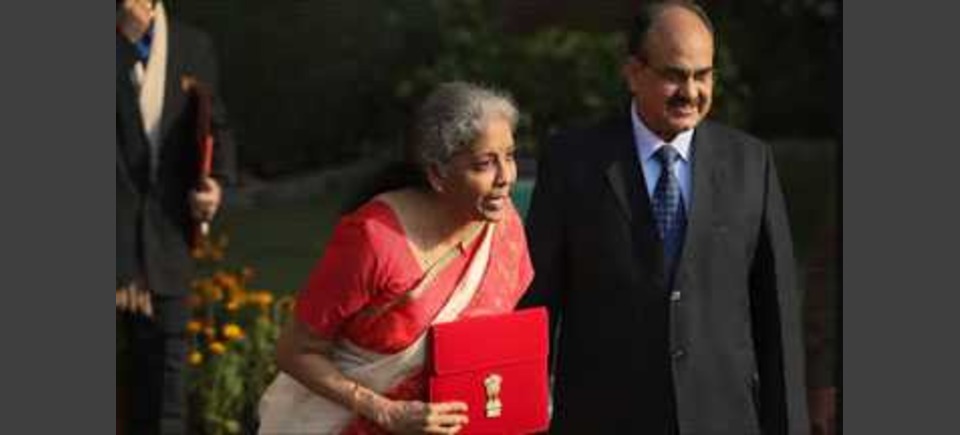
Budget 2022 expectations: Short-term relief, medium-term growth

Indian Finance Minister Nirmala Sitharaman will unveil the FY22-23 Union Budget on February 1, 2022. As we enter into the third – and hopefully final – year of COVID disruption, we expect India’s upcoming Budget will seek to balance short-term fiscal needs with structural reforms to support medium-term growth.

The Budget prospects going into the next fiscal year are relatively sunny. The past year has seen a strong recovery driven by private consumption and the release of pent-up demand. India’s nominal GDP grew significantly faster than expected, generating greater tax revenues to offset revenue losses elsewhere. Public investment, particularly on capital expenditures, also provided critical demand support as COVID-related uncertainty dragged down private investment.

However, the strong results over the past year were also partly the result of base effects and the recovery itself is still fragile, particularly as consumption reverts to normal levels and households look to rebuild their balance sheets. The omicron variant has also renewed economic uncertainty. Even without another full-scale lockdown substantial fiscal support will be required to keep the recovery on track. Charting the path forward is a challenge.

Given that backdrop, we expect the FY22-23 Budget to incorporate measures to boost welfare and generate growth in the short, medium, and long-terms.

First, we expect significant welfare spending to be the budget priority in the short-term. In light of the recent farmer protests, and statewide elections commencing in February, the government can take advantage of its strong revenue performance to continue important social supports. Subsidies for food and fertilizer have been a lifeline for vulnerable populations hit hardest by the pandemic and job guarantee schemes have played an important role in supporting domestic demand. These programs should continue as a necessary – albeit temporary –expenditure.

In addition, public spending on physical infrastructure to service secondary and tertiary care, integrating digital for primary and follow-up care and COVID-related medical interventions will rightly remain a top priority for the foreseeable future. Best practices have been built during COVID-19, particularly disease surveillance to enable early predictions and vaccine literacy to protect at-risk groups from various vaccine preventable diseases should be mainstreamed.

Second, we expect the finance minister will seek measures to boost the economy’s medium-term growth potential. Ideally, new measures will focus on promoting exports and domestic investment, to take advantage of structural changes in the global economy as real wages in other parts of Asia rise and trade and investment patterns shift. The Production Linked Incentives(PLIs) announced in the last budget were a positive step in this direction and should be expanded as much as possible in the coming year. The goal should be to unite “Make in India” with the demands of a shifting global supply chain and create the global manufacturing hub for labor-intensive, high value-added sectors that will deliver much needed employment.

Finally, to achieve sustainable long-term growth, the FY22-23 Budget must balance the competing needs of fiscal consolidation and large increases in capital spending. Finance Minister Sitharaman clearly recognizes macroeconomic stability is a prerequisite for long-term public investment, which in turn is necessary to crowd in the private and foreign investment needed to close India’s large infrastructure gap. The FY22-23 Budget is therefore likely to chart a path to fiscal deficits under 6 percent in the next two years, through a combination of expenditure discipline (for instance, no more fund for public bank recapitalization) and revenue enhancements (e.g. divestments and monetization of public assets).

The Budget will likely include an ambitious target for divestment revenues, possibly as high as Rs 1.5 trillion, or nearly three times the pre-pandemic targets. Though past experience in this area is not encouraging (actual divestments fell nearly Rs 2.5 trillion ($34 billion) short of the target over the past two years and the results of this year to date are no better), meeting an ambitious target in 2022 will be especially important. The economic benefit of a strong divestment program is indisputable, and the revenue generated is needed to pay for crucial social spending. The Budget is an opportunity to reaffirm the government’s commitment to divestment and outline a clear plan to sell at least 25 public sector units, including completing the huge IPO of Life Insurance Corporation (LIC) without delay.

Likewise, a strong focus on capital spending will raise the country’s growth potential and create jobs for millions of new employees every year. Research from the RBI shows that capital expenditures boost GDP growth more than any other category of public spending. The 25 percent increase in the capital spending budget last year was a great first step that should be matched by a similar increase this year.

Finally, we expect the forthcoming Budget will build upon recent efforts to strengthen India’s financial sector, the lifeblood of its economy. We look forward to new measures to broaden and deepen local capital markets and make it easier for investors to hedge the local currency.

A number of administrative reforms, such as easing restrictions on overseas listing of Indian start-ups and reducing regulatory burdens on Qualified Foreign Institutional Investors, would help Indian firms tap into global pools of capital. Other measures, such as reducing dominant role of government in banking and insurance markets though divestment and governance reforms, will make crucial financial services safer, cheaper, and more accessible to the vast majority of Indian citizens.

The FY22-23 Budget can also provide guidelines for eventual regulation of the fast-evolving crypto and digital asset space, a priority Minister Sitharaman touched on during her visit to the United States in late 2021. These measures will ensure consumer protection and financial stability without sacrificing innovation and growth.

With a focus on macroeconomic stability, fiscal discipline, revenue growth, and a shift from short term relief and medium-term recovery, the FY22-23 budget will chart India’s path back to sustainable growth and the pave the way towards a $5 trillion economy of its potential.

More Information
https://www.cnbctv18.com/finance/whats-in-store-for-budget-2022-short-term-relief-medium-term-growth-12296482.htm

Categories
USISPF in the News

urgent action to address distortions and inefficiencies in the banking sector

Days ahead of the annual budget, a top American business advocacy group, in a set of recommendations to the India’s Union Finance Minister, has recommended urgent action to address the distortions and inefficiencies arising out of regulatory mandates in the banking sector. Finance Minister Nirmala Sitharaman is scheduled to present her annual budget on February 1.

Washington DC-based US-India Strategic Partnership Forum (USISPF), which represents leading Fortune 500 companies, in a set of recommendations argued that to improve the ease of doing business for institutional investors, the process to register as Qualified Foreign Institutional Investor (QFII) should be streamlined, and the ability to adopt a single window clearance will enable smoother setting up of companies in India.

“Foreign investors can provide the billions in additional insurance equity capital needed to meet higher goals for insurance penetration, but existing restrictions discourage new foreign investment and undermine the 2021 reforms,” it said.

Should the 74 per cent cap on FDI remain, the GOI should address other complications like the three-party joint venture necessitated by the 20 per cent limit of bank ownership in insurers, it added. Having high expectations from the annual budget, USISPF said it should try to bring in tax stability and continuity, crucial factors in attracting investors.

A commitment to global tax norm will keep multinationals assured of tax certainty as they setup shop in India. Functional bottlenecks, ever-increasing TDS/TCS compliances, and a lack of clarity on overseas listings also impact ease of doing business, the forum noted.

Urging full transparency in the upcoming sale of shares in Life Insurance Corporation of India (LIC), USISPF said that reforms in the insurance sector should include eliminating the cap on foreign direct investment, permitting commercial credit cards for settlement of cashless claims to healthcare service providers and allowing insurance companies to set the commissions they pay to agents.

Budget 2022 should take specific steps to make it easier for customers and merchants to use digital solutions, including developing inter-operable QR codes, digitizing business to business (B2B) payments, ensuring the National Common Mobility Card (NCMC) is interoperable with global EMV standards, and expanding the digital payments backbone to underserved areas of the country, USISPF said.

More information
https://www.financialexpress.com/budget/budget-2022-usispf-recommends-urgent-action-to-address-distortions-and-inefficiencies-in-the-banking-sector/2417980/

Subscribe to our
Daily Newsletter Weekly Newsletter