
USISPF Unveils ‘State of Tourism in India 2026’ Report Tourism Positioned as Strategic Pillar for Economic Growth and Soft Diplomacy
The Hon’ble Vice President of India, Shri C. P. Radhakrishnan, today inaugurated the Tourism Leadership Summit 2026, convened by the U.S.-India Strategic Partnership Forum (USISPF) in collaboration with the Sankala Foundation at the USISPF Office, New Delhi. The summit brought together Union Ministers, senior government officials, global hospitality leaders, multilateral representatives, conservation experts, and industry stakeholders to deliberate on strengthening India’s tourism ecosystem and deepening U.S.–India travel and investment ties.
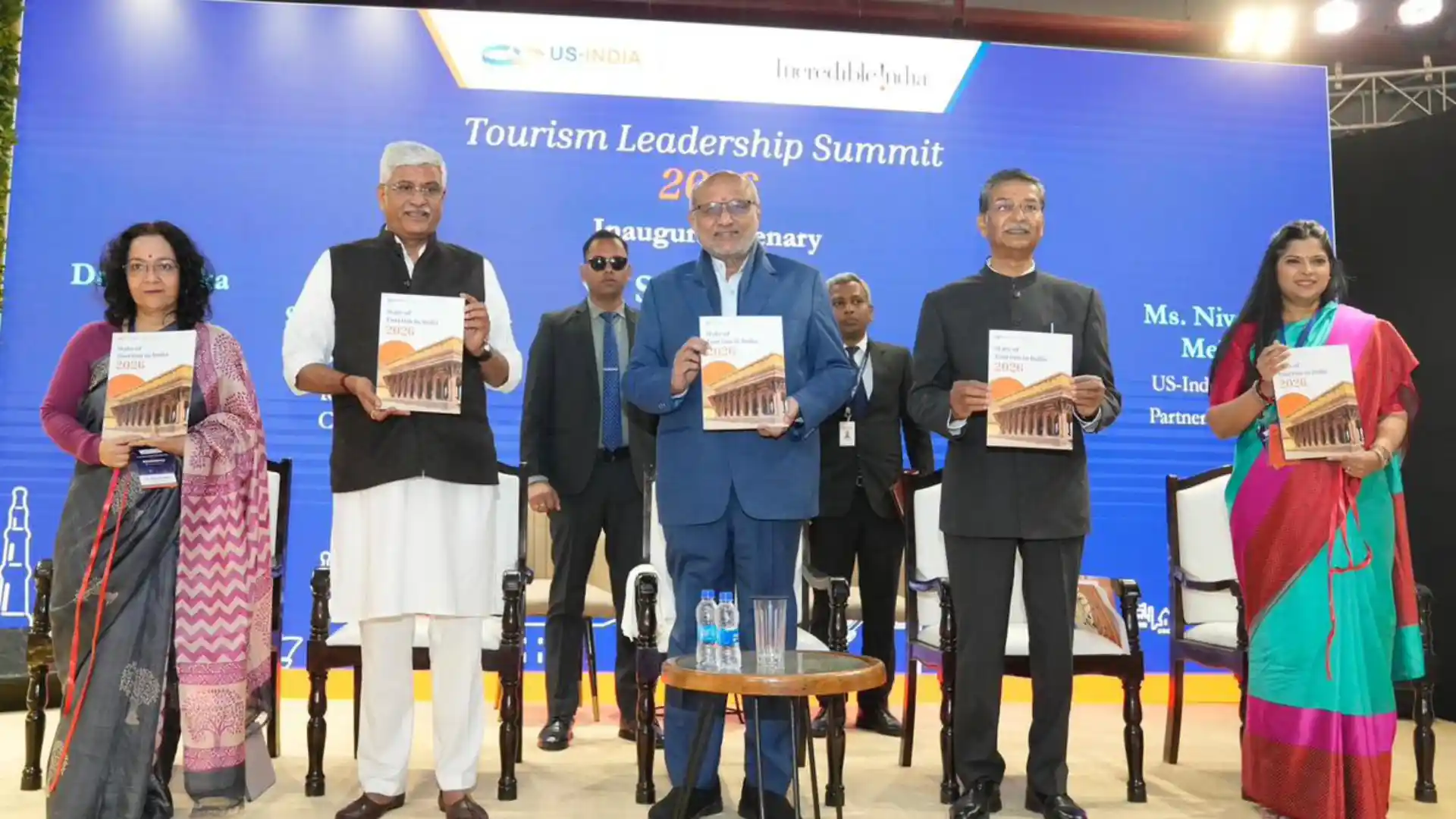
During the inaugural session, Shri Gajendra Singh Shekhawat, Hon’ble Union Minister for Tourism and Culture, Government of India, formally unveiled the USISPF report “State of Tourism in India 2026,” presenting the first copy to the Hon’ble Vice President. The report outlines a forward-looking roadmap for sustainable growth, digital transformation, investment expansion, and global positioning of India’s tourism sector.
Welcoming dignitaries and participants, Ms. Nivedita Mehra, Managing Director – India, USISPF, emphasized tourism’s growing global significance and India’s unique moment of opportunity. She remarked, “A country with a rich cultural heritage as India, brimming with youth, stands at the cusp of becoming the world’s most visited situation. We are at a critical inflection point where tourism is emerging. At USISPF, our mission has been to create the dynamic between US and India but also US and the world, where we see tourism as that bridge.”
In his inaugural address, the Hon’ble Vice President underscored tourism’s strategic importance to economic growth and international engagement, noting that, “Tourism is more than an industry. It is a bridge between cultures, a driver of economic opportunity, and a powerful instrument of soft diplomacy.” Highlighting the strength of bilateral engagement between the United States and India, he added, “The travel corridor between India and the United States reflects not only growing economic engagement, but also deep people-to-people ties, rooted in shared values, entrepreneurial spirit, and a vibrant diaspora.”
Shri Gajendra Singh Shekhawat emphasized tourism’s role as a powerful vehicle for cultural understanding and global connection, underscoring India’s unique civilisational depth and experiential richness. He remarked, “Tourism is about connection. When an American visits Varanasi, or explores the Himalayas, they experience the living history of India.”
The summit featured participation from leading policymakers, global corporations, and multilateral institutions. Distinguished speakers included Shri Bharat Lal, Secretary General and CEO, National Human Rights Commission of India; Mr. Amitabh Kant, Senior Advisor, Fairfax Financial Holdings and former G20 Sherpa of India; Mr. Stefan Priesner, United Nations Resident Coordinator in India, and Ambassador Harsh Vardhan Shringla, Hon’ble Member of Parliament, Rajya Sabha.
Industry leaders and global stakeholders joining the discussions included Rajeev Menon, President Asia Pacific (excluding China), Marriott International; Sandeep Ghosh, Group Country Manager – India & South Asia, Visa; Mahima Kaul, Head of Global Affairs, Netflix India; Mich Goh, Director of Public Policy APAC, Airbnb; alongside senior representatives from Expedia Group, WWF India, the International Big Cat Alliance, and the Ministry of Tourism, Government of India.
The day-long summit focused on building a globally competitive and sustainable tourism ecosystem. Discussions highlighted the importance of aligning conservation with economic opportunity through responsible wildlife tourism and eco-tourism models that generate livelihoods for local communities while safeguarding biodiversity. Leaders noted that India’s megadiversity and iconic wildlife position it uniquely on the global tourism map, supported by evolving policy frameworks that promote environmentally responsible growth.
Conversations also centered on institutional capacity-building, governance reforms, workforce skilling, and the integration of technology across tourism systems. Stakeholders emphasized that data-driven decision-making, digital platforms, artificial intelligence, and immersive technologies will shape the future of travel. Strengthening brand perception, improving ease of travel, expanding connectivity, and fostering public-private partnerships were identified as critical enablers in positioning India as a year-round, high-value global destination.
The summit concluded with a fireside conversation featuring Ambassador Harsh Vardhan Shringla, Hon’ble Member of Parliament, Rajya Sabha, reaffirming the government’s commitment to collaborative, reform-driven growth and cross-sectoral coordination in advancing India’s tourism and development priorities.
The USISPF Tourism Leadership Summit 2026 reinforced the shared resolve of government, industry, and global partners to elevate India’s tourism footprint and build a resilient, inclusive, and innovation-led tourism ecosystem.